

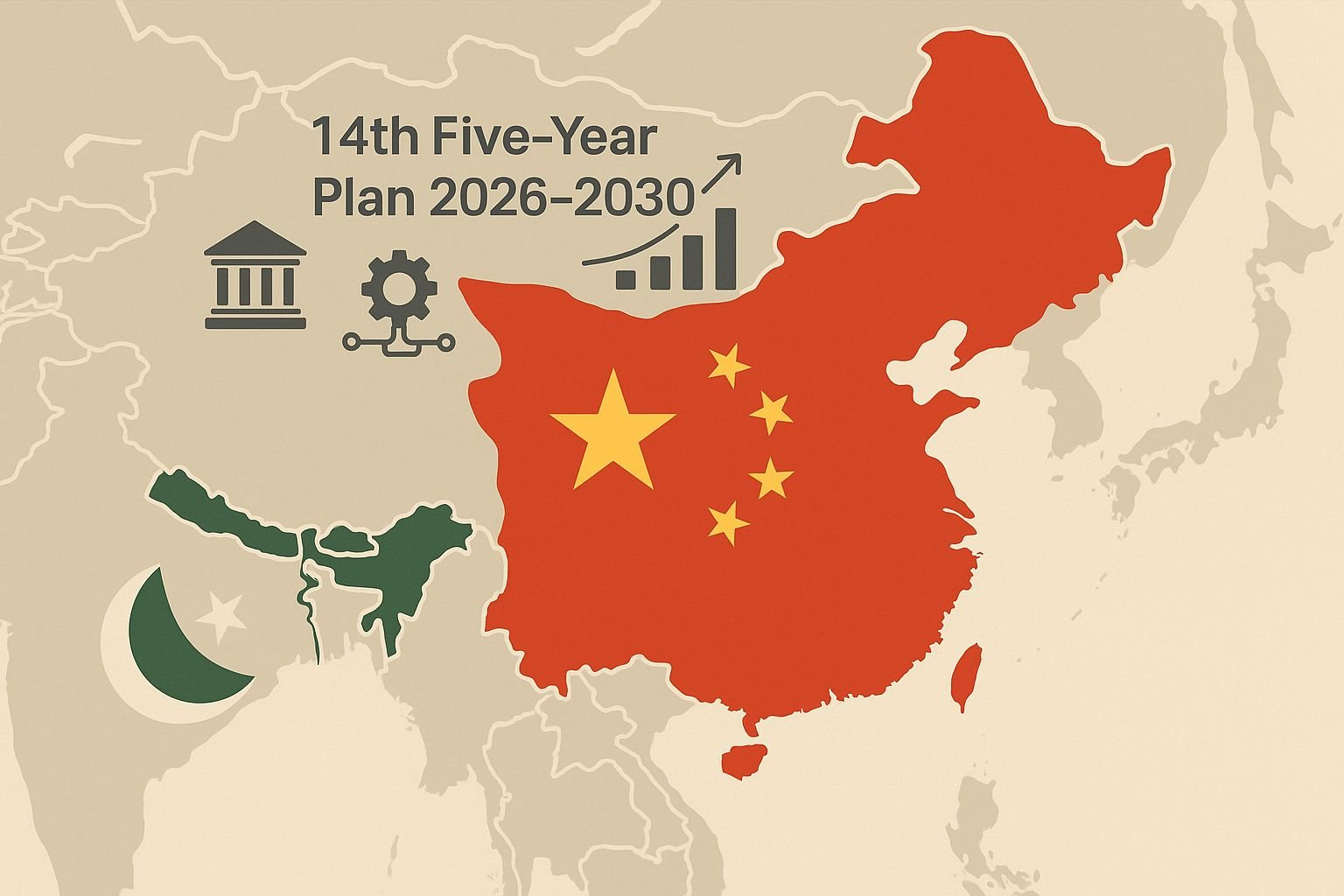

China’s five-year plan for 2026–2030 places strong focus on institutional modernization, administrative efficiency, and long-term policymaking. As Beijing advances toward its 2035 goal of comprehensive modernization, the Communist Party of China (CPC) is prioritizing merit-based governance, digital oversight, and evidence-driven policy reforms. For Pakistan, where implementation gaps remain a major challenge, China’s approach provides practical guidance for strengthening governance systems.
Digital transformation becomes a core pillar
The Fourth Plenary Session of the 20th CPC Central Committee has presented a roadmap for building a high-standard socialist governance system aligned with China’s strategic objectives. A major pillar of the new plan is digital transformation across public administration. China aims to expand the use of big data, cloud computing, and artificial intelligence for predictive modelling, automated auditing, and smart city management.
Pakistan has already taken steps toward digitizing tax systems and public services. The creation of a unified national data platform—linking ministries, provinces, and districts—could reduce duplication, improve transparency, and strengthen evidence-based decision-making.
Meritocracy central to China’s governance model
Institutional meritocracy is another area where Pakistan can draw lessons. China’s cadre system promotes officials through rigorous performance assessments and continuous training. This ensures technical competence and accountability at all levels.
For Pakistan, depoliticizing administrative appointments and developing specialized career tracks in sectors such as technology, finance, and energy could help attract and retain professional talent in government institutions.
Long-term planning ensures policy continuity
China’s planning model aligns five-year plans with 15-year and 30-year visions. This structure provides continuity across political cycles and ensures short-term projects support long-term national goals.
Pakistan’s Vision 2025 and related frameworks could benefit from similar stability. Establishing a permanent National Development Coordination Council, modelled on China’s National Development and Reform Commission, would help minimize frequent policy shifts and improve planning discipline.
Public service delivery shifts toward integrated systems
China’s new plan also focuses on integrating social welfare, healthcare, and education systems through unified data platforms to improve service delivery. Pakistan’s fragmented public service systems could benefit from adopting interoperable models that allow provincial departments to share information and coordinate interventions more effectively.
Anti-corruption efforts rely on digital tracking
Accountability and anti-corruption remain central to China’s governance agenda. Through centralized supervision and digital tracking of public expenditure, China has reduced leakages and improved public spending efficiency. Pakistan could adopt similar digital tools, strengthen financial management systems, and expand e-procurement across development projects.
Rule-based governance strengthens institutions
China’s emphasis on rule-based governance ensures that institutions operate according to the law, with clearly defined administrative responsibilities. For Pakistan, comprehensive civil-service reforms and updated regulations could empower departments to act effectively while ensuring proper oversight.
Institutional learning through partnerships
Institutional exchanges between Pakistan and China could support administrative modernization. Knowledge sharing in areas such as local government finance, digital auditing, and infrastructure management can provide practical insights for reforming Pakistan’s governance systems.
Strong institutions key to sustainable development
Overall, China’s 2026–30 plan highlights the importance of strong institutions as the foundation of sustainable growth. Aligning Pakistan’s governance reforms with these principles could strengthen project delivery, financial management, and public trust. Stronger institutions would also enhance the credibility of Pakistan’s development agenda and help attract more foreign investment.
Expert views support China-inspired reforms
Dr. Abdul Jalil, Head of the Department of Economics at National Defence University, told Wealth Pakistan that Pakistan could benefit significantly from China’s 2026–30 Governance Reform Plan. He said the focus on institutional discipline and digital transformation is especially relevant for Pakistan, where governance challenges often stem from bureaucratic delays and weak coordination.
He noted that linking federal and provincial data platforms could streamline processes, enhance transparency, and boost accountability. The use of big data and artificial intelligence, he added, could strengthen public service delivery and reduce corruption. He said China’s meritocratic system offers a useful model for depoliticizing Pakistan’s civil service.
Speaking to Wealth Pakistan, Dr. Ikhtiyar Baig MNA, Member of the National Assembly Standing Committee on Commerce, said China’s plan offers an insightful roadmap for countries seeking to modernize institutions. He said China’s ability to align long-term goals with achievable reforms is a major lesson for Pakistan.
He added that China’s accountability mechanisms and performance-linked monitoring could strengthen Pakistan’s CPEC projects, industrial policy, and climate adaptation plans. Integrating big data for predictive modelling, he said, could help overcome delays and improve the effectiveness of public-sector initiatives. He noted that China’s focus on meritocracy and decentralized governance could support a more responsive administrative system in Pakistan.