

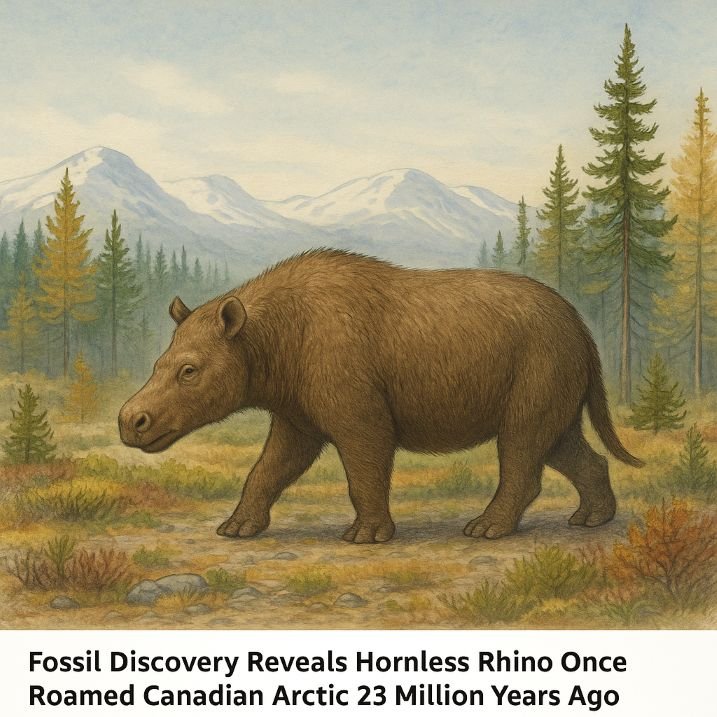

LONDON, Oct 28 (Reuters) – Scientists have discovered the fossilized remains of a previously unknown rhinoceros species that once lived in the Canadian High Arctic about 23 million years ago — a region that, while warmer than today, still endured months of snow and darkness.
The animal, named Epiaceratherium itjilik or “polar rhino,” lived during the early Miocene epoch and represents the first known rhino species to inhabit such high latitudes. The fossil was unearthed on Devon Island in Nunavut, Canada, within Haughton Crater — one of the world’s northernmost meteor impact sites.
Arctic fossil sheds light on mammal evolution
Researchers found roughly 75 percent of the animal’s skeleton preserved in permafrost, providing rare insights into how large mammals adapted to ancient Arctic ecosystems. Measuring about one meter tall at the shoulder, the polar rhino was comparable in size to today’s Indian rhinoceros but lacked a horn.
“Devon Island during the Miocene was much more temperate and forested, quite unlike the polar desert that exists there today,” said Danielle Fraser, head of palaeobiology at the Canadian Museum of Nature and lead author of the study published in Nature Ecology & Evolution.
Fraser said summers were mild while winters brought snow and long periods of darkness — similar to the modern climate of southern Ontario or northern New York. “It remains a mystery how animals like a rhino survived, though modern mammals use hooves and antlers to dig through snow for food,” she added.
A temperate Arctic forest teeming with life
The fossilized pollen and plant remains from the site suggest that the rhino lived in a forested environment dominated by pines, spruce, birch, larch, and alder. The rhino’s narrow muzzle indicates it fed primarily on the leaves of trees and shrubs — similar to modern browsing species.
Fraser said the Arctic may have played a more significant role in mammalian evolution than previously thought. “We often think about the tropics as biodiversity centers, and they are,” she explained. “But these discoveries show that the Arctic was also crucial in shaping mammal evolution.”
The researchers believe Epiaceratherium itjilik may have had a thick coat of fur to endure the freezing winters — much like the woolly rhinoceros that roamed Eurasia during the Ice Age, though the two species were not closely related.
Genetic insights and migration mystery
In a related study published in July, scientists extracted ancient proteins from the rhino’s tooth enamel — a major breakthrough since proteins can survive far longer than DNA. The analysis helped clarify the animal’s place in the rhinoceros family tree, showing that its closest relatives lived in Europe, the Middle East, and southwestern Asia.
This finding suggests that rhino ancestors crossed from Europe into North America via Arctic land bridges that remained passable millions of years longer than previously believed. “Our study shows rhinos were crossing for at least 20 million years longer than we thought,” Fraser said.
Geological evidence supports this, indicating that routes over Iceland and Greenland, as well as from Finland through Svalbard, remained intermittently open during the Miocene — providing migration corridors between continents.
Expanding the known range of ancient rhinos
The discovery expands scientists’ understanding of how adaptable early rhinos were and reshapes theories about Arctic ecosystems in prehistoric times. Other fossils recovered from the same site include those of Puijila darwini, an early seal species with feet rather than flippers — further evidence of evolutionary transition in the region.
Rhinos first appeared about 48 million years ago and once ranged across every continent except South America and Antarctica. While only five species survive today, over 50 are known from the fossil record.
“The polar rhino discovery reminds us that ancient ecosystems were dynamic, interconnected, and resilient,” Fraser said. “The Arctic was not a frozen wasteland — it was a thriving cradle of evolution.”
This news was originally published by Reuters.