

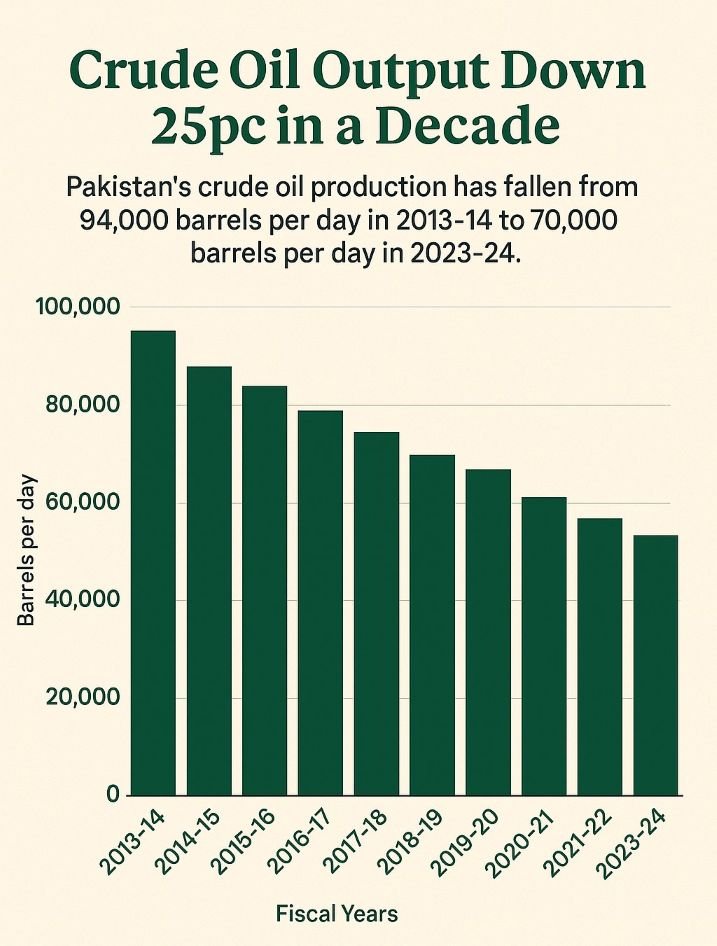

ISLAMABAD, Nov 6 (INP-Wealth Pakistan): Pakistan’s crude oil production has dropped by one-quarter over the past decade despite minor annual gains, as the country’s reserves near exhaustion with less than ten years of supply remaining at the current extraction rate.
Production inches up but remains weak
In fiscal year 2023-24, crude oil production increased by about two percent from the previous year due to limited new discoveries and better recovery from mature fields. However, overall output stayed restricted, reflecting low exploration activity and limited upstream investment.
Reserve base and regional distribution
According to the Pakistan Energy Market Review 2025 by Renewables First, Pakistan’s proved and probable reserves, or 2P reserves, stood at 1,304 million barrels by the end of FY24, up six percent from 1,229 million barrels a year earlier. The marginal increase came mainly from new exploration in Sindh and Khyber Pakhtunkhwa. Sindh held 44 percent of total reserves, Punjab 35 percent, and Khyber Pakhtunkhwa 16 percent.
Fields nearing exhaustion
Cumulative production had reached 81 percent of the total 2P reserves by June 2024, showing the depletion of Pakistan’s mature fields. The reserves-to-production ratio slightly improved to 9.4 years in FY24 from 7.6 years a year earlier, mainly due to slower output instead of significant new reserves. Without major new finds, the country’s current reserves could be exhausted within a decade.
Long-term decline in output
Average production during FY24 stood at around 70,000 to 71,000 barrels per day, roughly 3.5 million tonnes of oil equivalent. Although marginally higher than the previous year, this level remains far below FY15’s 94,000 barrels per day. The steep decline reflects chronic issues in Pakistan’s upstream petroleum sector, including investor uncertainty, foreign exchange shortages, and slow regulatory approvals.
Exploration slowdown and investor retreat
The report said limited exploration activity and the aging of key reservoirs have curbed domestic output. Several major fields in southern Sindh and central Punjab have passed their production peaks. Many foreign companies have scaled back operations because of delays in licensing, security challenges, and unattractive fiscal returns.
Imports fall amid weaker demand
Crude oil imports declined for the second straight year, mirroring reduced refinery demand and lower consumption of petroleum products. Pakistan imported 8.5 million tonnes of oil equivalent in FY24, down from 11.7 Mtoe in FY22, a drop of 24 percent in two years. Petroleum product imports also fell 18 percent to 7.1 Mtoe. The contraction eased external pressure but mainly reflected weak economic activity rather than domestic substitution.
Refinery performance and challenges
Refineries processed 12 Mtoe of crude oil in FY24, up 11 percent from the previous year, with 71 percent imported and 29 percent locally produced. Output remained dominated by high-speed diesel, furnace oil, and motor spirit, which made up 85 percent of production. The refining sector continues to struggle with outdated technology, narrow margins, and low investment in capacity upgrades.
Structural risks and policy gaps
The temporary rebound in refinery utilization cannot offset the long-term decline in the sector, which threatens energy security and raises reliance on imported fuels. The depletion of reserves and dependence on imports expose the economy to global price shocks and exchange-rate swings.
Need for urgent policy reforms
Renewables First stressed that reversing the production decline requires urgent reforms, including improved fiscal incentives, transparent licensing, and technology upgrades to attract new investors. Without these measures, Pakistan’s crude oil base will keep shrinking, further deepening dependence on imported energy and weakening long-term energy stability.