

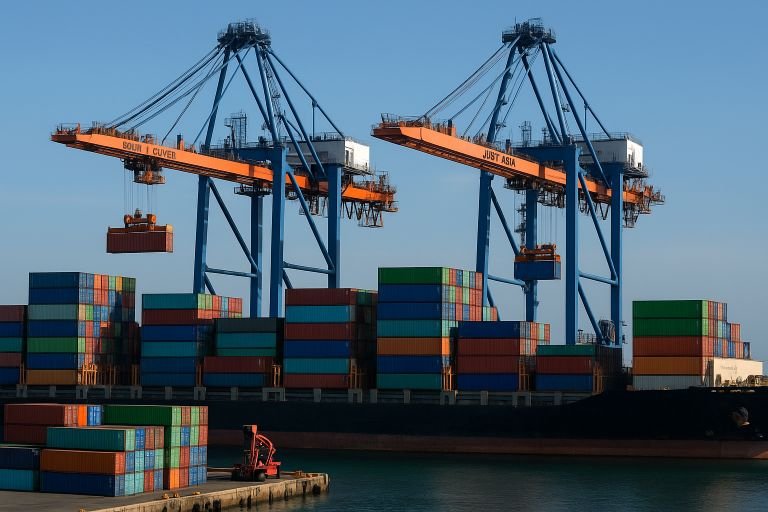

Pakistan’s external trade landscape presents a mixed picture in the first quarter of FY2025-26: a widening deficit but also clear signs of resilience in exports and underlying industrial recovery. The latest official data suggests that while import demand is rebounding faster than export earnings, the composition of trade flows indicates renewed momentum in domestic production and supply chains.
Encouraging uptick in monthly exports
According to the Ministry of Commerce, exports in September 2025 stood at $2.5 billion, compared with $2.4 billion in August — a modest but positive increase of 3.48 percent. In rupee terms, exports rose 3.04 percent to Rs703 billion from Rs683 billion.
However, on a year-on-year basis, exports declined 11.85 percent from $2.8 billion recorded in September 2024, reflecting the lingering impact of slower global demand and commodity price adjustments.
For the first quarter (July–September 2025-26), exports totalled $7.6 billion — a 3.88 percent decline from $7.9 billion during the same period last year. In rupee terms, quarterly exports amounted to Rs2,149 billion, down 2.32 percent compared to Rs2,200 billion in the corresponding period of FY2024-25.
Imports rebound amid industrial recovery
Imports showed a sharper rise, pointing to recovering domestic activity and higher energy inflows. Total imports during September reached $5.9 billion, up 11.63 percent from $5.3 billion in August. In rupee terms, imports climbed 11.33 percent to Rs1,664 billion from Rs1,495 billion.
Compared with September 2024, imports were up 15.16 percent in dollar terms and 16.49 percent in rupees, indicating stronger import demand as industrial and infrastructure projects gain traction.
Cumulatively, imports during the first quarter of FY2025-26 stood at $17 billion — an increase of 13.88 percent from $14.9 billion in the same quarter last year. In rupee terms, imports reached Rs4,818 billion, up 15.57 percent from Rs4,169 billion.
Trade deficit widens but remains manageable
As a result, the trade deficit widened in September but stayed within a manageable range. The gap expanded to $3.4 billion from $2.8 billion in August — an 18.49 percent month-on-month increase. In rupees, the deficit rose 18.30 percent to Rs960 billion from Rs812 billion.
Year-on-year, the deficit widened 48.58 percent in dollar terms and 50.16 percent in rupees. For the July–September quarter, the overall trade deficit reached $9.4 billion, up 33.80 percent from $7.0 billion during the same period last year. In rupees, the gap increased 35.57 percent to Rs2,668 billion from Rs1,968 billion.
Exports show resilience despite global slowdown
Despite these pressures, officials note that export performance — though below last year’s peak — remains relatively stable in the face of weak global demand and domestic cost challenges. The recent pickup in monthly exports and the steady rupee-dollar exchange rate suggest that Pakistan’s manufacturing and agro-based exports are holding ground.
“The narrowing quarterly export contraction and higher import volumes suggest normalisation in trade flows and improving industrial sentiment,” a senior official observed.
Cautious optimism for coming months
While the export-to-import ratio slipped to 42.3 percent in September from 45.7 percent in August, the underlying trends show that Pakistan’s export base remains active. Stronger energy imports, machinery inflows, and improving order books point to early signs of reactivation in industrial production.
Economists argue that the coming quarters will test whether the modest export revival can sustain against a strengthening import rebound. Nonetheless, the momentum seen in September underlines that Pakistan’s external sector is gradually moving from contraction to recovery — a sign that policy stability and improved logistics are beginning to yield results.