

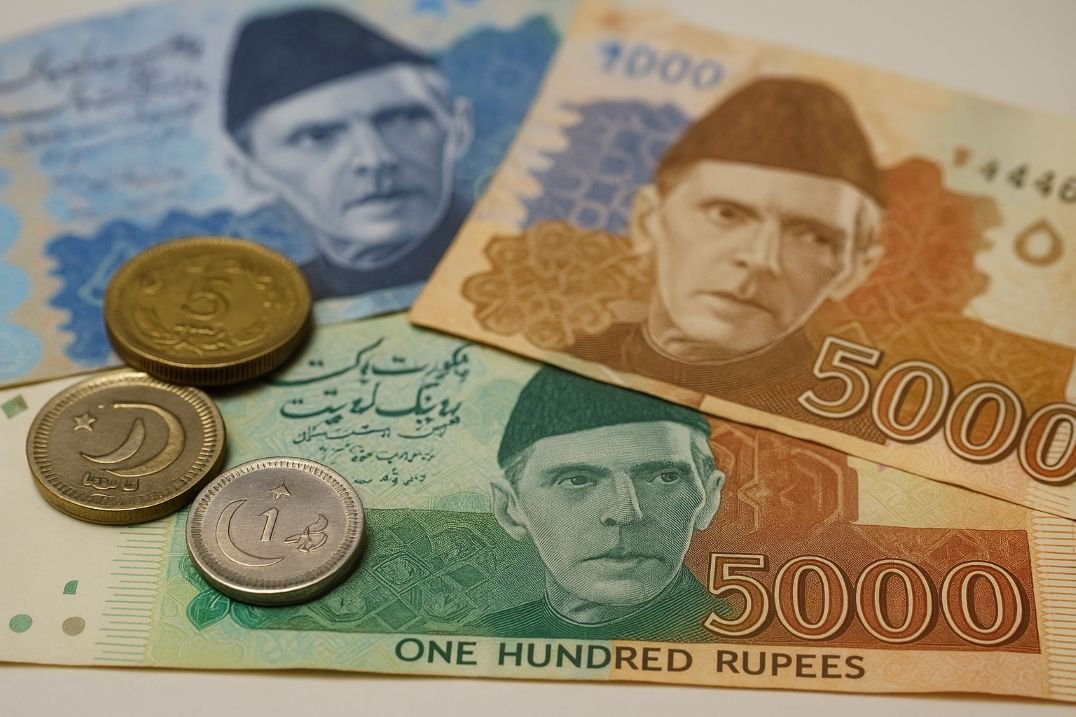

ISLAMABAD, Nov 2 (Wealth Pakistan): The Pakistani rupee remained stable throughout October 2025, showing only mild fluctuations against major global currencies as prudent exchange management, improved foreign inflows, and steady macroeconomic indicators supported overall market sentiment.
Monthly Performance
According to the State Bank of Pakistan (SBP), the rupee began the month at Rs281.0732 (buying) and Rs281.5051 (selling) against the US dollar. It moved slightly to Rs280.9751 and Rs281.4069 by October 7, remained steady at Rs280.9425 and Rs281.3744 mid-month, and closed at Rs280.6969 and Rs281.1288 on October 31 — maintaining near-stable parity across the month.
Movement Against Major Currencies
In the euro market, the rupee opened at Rs330.4994 and Rs331.0055, firmed to Rs328.4997 and Rs329.0014 by October 7, then fell to Rs325.1227 and Rs325.6437 mid-month. It briefly recovered to Rs327.3644 and Rs327.8733 on October 28 before closing slightly weaker at Rs324.6896 and Rs325.1943.
The British pound showed similar volatility, starting at Rs378.4221 and Rs379.0087, dipping to Rs373.8380 and Rs374.2833 by mid-October, and ending lower at Rs369.0394 and Rs369.6222. The Saudi riyal traded within a narrow range, opening between Rs74.9424 and Rs75.0521 and closing slightly lower at Rs74.8506 and Rs74.9599.
The Japanese yen weakened from Rs1.9073 and Rs1.9102 on October 1 to Rs1.8223 and Rs1.8250 by the month’s end, while the Chinese yuan remained stable, moving from Rs39.4793 and Rs39.5311 to Rs39.4595 and Rs39.5116.
Expert Views
Syed Zafar Abbas, Manager at Zahid Latif Khan Securities, told Wealth Pakistan that the rupee’s gradual appreciation reflected strong administrative measures implemented under the government and the Special Investment Facilitation Council (SIFC). “Foreign currency movement, especially in dollars, has been tightly managed, curbing speculation and supporting economic activity,” he said, adding that roughly USD 20 billion had been absorbed from the market over recent years to reinforce foreign exchange reserves.
Muhammad Bilal Ejaz, Research Analyst at Ismail Iqbal Securities, said the rupee’s performance in October was underpinned by stable policy rates and an improving current account balance. “The current account posted a USD 110 million surplus in September 2025, compared to a USD 325 million deficit a year earlier, taking the cumulative 3MFY26 deficit to USD 594 million,” he added.
Economic Indicators
Key economic indicators reflected stability in fundamentals. The Pakistan Bureau of Statistics reported a USD 3.3 billion trade deficit in September 2025, with exports at USD 2.5 billion and imports at USD 5.8 billion, bringing the first-quarter FY26 trade deficit to USD 9.4 billion. GDP grew by 3.04 percent in FY25, while public debt declined 1 percent month-on-month to PKR 77.5 trillion in August.
Remittances rose 11 percent year-on-year to USD 3.18 billion in September, taking first-quarter FY26 inflows to USD 9.6 billion. Inflation stood at 5.6 percent year-on-year in September, up from 3.0 percent in August.
IMF Agreement and Outlook
Pakistan’s staff-level agreement with the International Monetary Fund (IMF) under the USD 7 billion Extended Fund Facility (EFF) and USD 1.3 billion Resilience and Sustainability Facility (RSF) further boosted market confidence. The Real Effective Exchange Rate (REER) also strengthened to 101.73 in September from 100.09 in August, indicating improved competitiveness.
Analysts believe October’s currency stability was the result of effective policy coordination, stronger external balances, and disciplined exchange management. They expect the rupee to remain stable heading into November as macroeconomic stability continues to improve.