

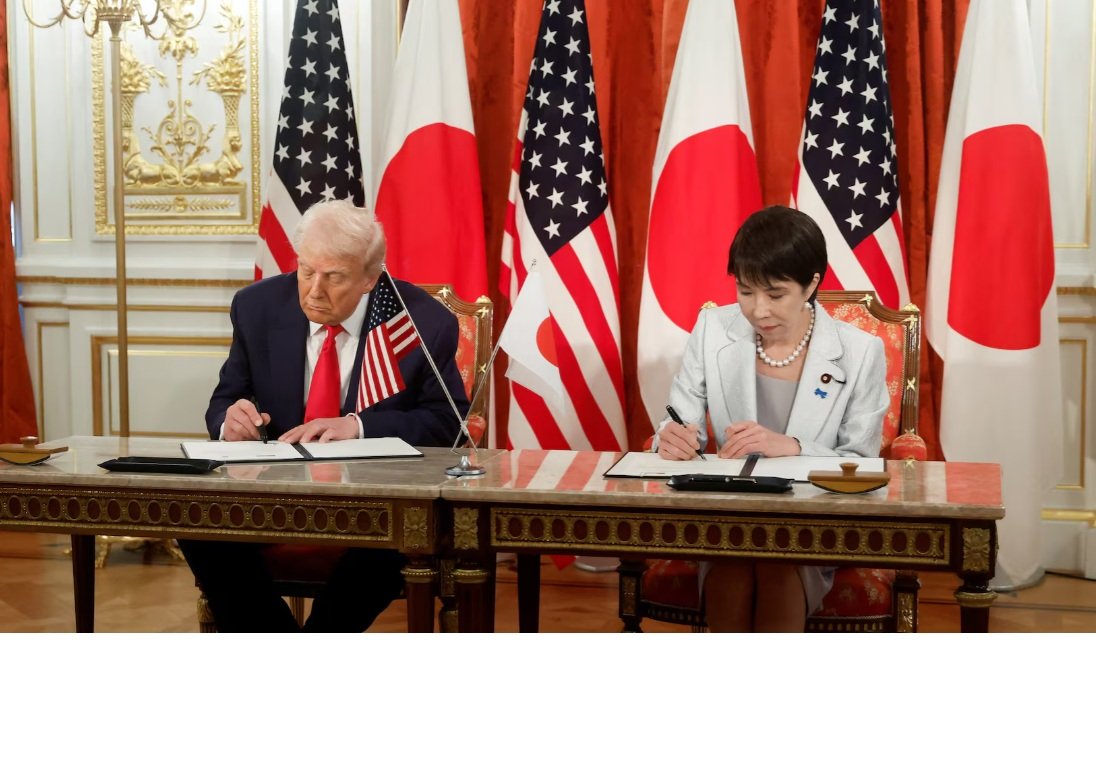

TOKYO, Oct 28 (Reuters) – U.S. President Donald Trump and Japan’s new Prime Minister Sanae Takaichi on Tuesday announced a major agreement on critical minerals and rare earths, while pledging deeper economic and security cooperation during their first bilateral meeting in Tokyo.
The talks — marked by warm personal gestures and symbolic tributes to former Prime Minister Shinzo Abe — also saw both leaders highlight plans for expanded Japanese investment in the U.S. and Tokyo’s accelerated military buildup amid regional security concerns.
New era in Japan-U.S. relations
Takaichi, Japan’s first female prime minister and a protégé of the late Abe, used her debut summit with Trump to reinforce the continuity of Tokyo’s strategic partnership with Washington. She pledged to fast-track defence spending to 2 percent of GDP and reaffirmed Japan’s commitment to shared Indo-Pacific security goals.
“Everything I know from Shinzo and others tells me you will be one of the great prime ministers,” Trump said during their talks at Tokyo’s Akasaka Palace. “Becoming Japan’s first female prime minister is a big deal.”
According to officials, the two sides also discussed cooperation on energy, artificial intelligence, and industrial supply chains. A joint statement outlined plans for Japanese investments of up to $400 billion in U.S. technology and infrastructure projects.
Earlier this year, Tokyo pledged $550 billion in loans, guarantees, and strategic U.S. investments as part of a broader arrangement that secured a reprieve from American import tariffs.
Rare earths deal aims to cut China dependence
A key outcome of the summit was a new deal to strengthen supply chains for critical minerals and rare earth elements, essential for electronics and defence production. Both sides emphasized the need to diversify away from China’s dominant position in global supply chains.
Trump praised Japan for “stepping up to help secure the world’s energy and technology future,” adding that the agreement marked “a new chapter in U.S.-Japan economic leadership.”
Takaichi said Japan would boost purchases of U.S. defence equipment and expand industrial cooperation. “This is about ensuring stability, security, and technological self-reliance for both our nations,” she said.
Symbolism and legacy diplomacy
Throughout the visit, Takaichi sought to evoke Abe’s legacy, presenting Trump with the late leader’s golf putter encased in glass, a signed golf bag from Japanese major winner Hideki Matsuyama, and a gold-leaf golf ball. Trump later met Abe’s widow, Akie Abe, who gifted him a painting emblazoned with the word “PEACE.”
Abe, assassinated in 2022, was the first foreign leader to meet Trump after his 2016 election victory, and the two had forged an unusually close rapport over multiple rounds of golf in the U.S. and Japan.
Over a lunch featuring American beef and rice alongside vegetables from Takaichi’s hometown of Nara, the Japanese leader presented Trump with a map showcasing major investments by Japanese companies since his last visit in 2019. Firms including Mitsubishi Heavy Industries, SoftBank, Hitachi, Murata, and Panasonic were listed among those planning new U.S. ventures.
Trump announced that Toyota would invest $10 billion to expand its auto manufacturing operations in the U.S., and said Japan planned to import Ford’s iconic F-150 pickup trucks — rare on Japanese roads.
Domestic and regional dimensions
Analysts said Takaichi’s strategic alignment with Trump could help strengthen her politically at home, where her coalition remains two seats short of a lower house majority. Her firm stance on defence and continuity with Abe’s foreign policy may bolster her image as a strong leader navigating uncertain global dynamics.
Trump and Takaichi also discussed Japan’s long-standing issue with North Korea over citizens abducted in the 1960s and 1970s. After meeting families of the abductees, Trump reaffirmed U.S. support, saying Washington was “with them all the way.”
Naval visit underscores defence ties
Later in the day, Trump and Takaichi flew by helicopter to the U.S. aircraft carrier George Washington, docked at the Yokosuka naval base. Addressing 6,000 U.S. sailors, Trump praised Japan’s military cooperation and announced that deliveries would soon begin for Japan’s long-awaited order of U.S. missiles for its F-35 fighter jets.
“This woman is a winner,” Trump told the crowd, ushering Takaichi to the stage as a show of alliance unity.
Japan currently hosts the largest concentration of U.S. military forces outside American territory, a central pillar of the bilateral security framework.
Toward a trade thaw and regional diplomacy
Trump’s five-day Asia tour — his longest foreign trip since returning to office in January — began in Malaysia and will conclude with a planned meeting in South Korea with Chinese President Xi Jinping. U.S. officials said the encounter aims to ease trade tensions and signal stability in a region marked by growing geopolitical rivalry.
As the day ended, Trump met with business leaders in Tokyo, engaging in an animated exchange with SoftBank CEO Masayoshi Son about golf — before delivering a wide-ranging speech touching on the economy, sports, and U.S. domestic politics.