
Home Blog Page 13

Xi calls for high standards in building Hainan Free Trade Port

0

SANYA, Nov 6 (Xinhua): Chinese President Xi Jinping has called for adopting high standards in the construction of the Hainan Free Trade Port (FTP), urging coordinated and sustained efforts to make it a model of reform and opening up in the new era.

Xi, who is also general secretary of the Communist Party of China (CPC) Central Committee and chairman of the Central Military Commission, made the remarks while reviewing progress on the Hainan FTP in Sanya, south China’s island province of Hainan.

Major step toward deeper reform

Xi said building the Hainan FTP is a major policy decision of the CPC Central Committee to comprehensively deepen reform and expand opening up. He urged officials to fully implement the guiding principles of the fourth plenary session of the 20th CPC Central Committee and achieve the targets of FTP development through close coordination and proactive actions.

The Hainan Free Trade Port will officially launch its island-wide special customs operations on December 18, which Xi described as a landmark move showcasing China’s commitment to high-standard openness and an open world economy.

Framework for high-level opening up

To turn Hainan into a key gateway for China’s reform and opening up, Xi emphasized the need to fully implement the FTP master plan and the Hainan Free Trade Port Law. He said policy frameworks and institutional systems must be built in stages to match international standards.

He called for expanding institutional openness, advancing trade and investment liberalization, and improving cross-border flows of capital, goods, and talent. Xi also urged reforms in talent recruitment, administrative management, and business environment development to make Hainan more competitive, market-oriented, and law-based.

Driving high-quality development

Xi said high-standard construction of the Hainan FTP is central to advancing Hainan’s high-quality growth and contributing to the country’s new development paradigm. The province, he added, should focus on its strategic roles as a pilot zone for comprehensive reform, a national ecological conservation hub, an international tourism and consumption destination, and a service base for national strategies.

He called for building a modern industrial system that leverages Hainan’s strengths, promotes industrial upgrading, and integrates technology and innovation to develop new productive forces.

Regional and ecological integration

Xi said Hainan should lead in high-standard opening up by strengthening cooperation with the Guangdong-Hong Kong-Macao Greater Bay Area and deepening links with other key regions including the Beijing-Tianjin-Hebei corridor, the Yangtze River Delta, and the Yangtze Economic Belt. He also urged deeper integration into the Belt and Road framework.

Highlighting Hainan’s ecological importance, Xi called for advancing the high-quality development of its ecological conservation pilot zone while improving public well-being and promoting common prosperity.

Ensuring safety and integrity

Xi stressed the importance of pursuing development while ensuring security, saying the province must open up in a scientific and orderly way and identify potential risks early.
He also emphasized full and rigorous Party self-governance, calling for integrity in governance and continued anti-corruption efforts.

Xi instructed officials to closely monitor Typhoon Kalmaegi and take concrete steps for prevention and emergency response to minimize potential losses.

Cai Qi, a member of the Standing Committee of the Political Bureau of the CPC Central Committee and director of the General Office of the CPC Central Committee, attended the meeting.

This news was originally puublished by Xinhua.

Toy Hall of Fame welcomes Slime, Battleship and Trivial Pursuit

0

ROCHESTER, Nov 6 (AP): Slime — the gooey, stretchy plaything loved by generations — has officially joined the National Toy Hall of Fame alongside two timeless games, Battleship and Trivial Pursuit.

Honoring toys that shaped play

Each year, the Hall of Fame selects a handful of toys that have inspired creative play across generations. The finalists are chosen from thousands of nominations submitted online, with the final picks decided by public voting and a panel of experts.

Battleship and Trivial Pursuit make waves

Milton Bradley’s Battleship and the trivia classic Trivial Pursuit have each sold more than 100 million copies over the decades, according to the Hall of Fame.
Battleship began as a pencil-and-paper strategy game in the 1930s before Milton Bradley released its plastic version in 1967. The game became a cultural icon, spawning computer adaptations in 1979 and even a 2012 Hollywood film produced by Universal Pictures and Hasbro.

Trivial Pursuit, invented in 1979 by Canadian journalists Chris Haney and Scott Abbott, quickly became a social favorite. The game challenges players to collect wedges by answering questions in categories such as geography, entertainment, and sports. Hasbro now owns the rights and continues to release themed editions for different age groups and interests, while an online daily quiz keeps fans engaged.

Slime sticks around

Slime’s appeal lies in touch rather than competition. Introduced commercially in 1976, it remains popular both as a store-bought toy and a DIY activity. Online tutorials offer countless recipes using glue, baking soda, and contact lens solution.
Curator Michelle Parnett-Dwyer said that despite its “icky” reputation, slime offers meaningful play through sensory stimulation, stress relief, and motor skill development.

A permanent place among classics

The new inductees will be featured permanently at The Strong National Museum of Play in Rochester, New York.
This year, they were selected over other nominees including Connect Four, Catan, the Spirograph drawing set, the Star Wars lightsaber, Furby, and Tickle Me Elmo — as well as perennial favorites like scooters, cornhole, and snow play.

Thius news was originally published by The Associated Press.

Dodgers celebrate back-to-back World Series titles in LA parade

0

LOS ANGELES, Nov 6 (CNN): Thousands of fans turned downtown Los Angeles into a sea of blue as the Dodgers celebrated their second straight World Series title with a victory parade that brought the city to a joyous standstill.

City turns blue for champions

Crowds lined the streets for hours, waving flags and cheering as double-decker buses carried the players, their families, and the Commissioner’s Trophy through the heart of the city. Many fans had camped out since the early morning to secure front-row spots.

Alejandro Alba and his son Jayen arrived at 4 a.m., seven hours before the parade began. “Last year I couldn’t make it because of work,” Alba said. “But I promised my son we’d be here this time. I told him, ‘You’re not going to school today. We’re going to the parade.’”

A fanbase united in celebration

Among the crowd was a longtime supporter known as Blue Foo, who designed a custom World Series jacket covered in Dodger championship patches. For him, this year’s win felt extra special.
“It was a tough series,” he said. “We respect the Blue Jays, but we were the better team. That was a good series.”

Comeback for the ages

The Dodgers clinched the championship in dramatic fashion, coming from behind to win Game 7 of the Fall Classic on Saturday. The Blue Jays were two outs from the title when Miguel Rojas hit a solo homer to tie the game at 4-4. In the 11th inning, Will Smith launched a go-ahead home run, giving the Dodgers their first lead.
Ace pitcher Yoshinobu Yamamoto sealed the victory with a double play, earning his third win of the series.

A city finds its joy

After a tense summer marked by immigration enforcement crackdowns, the Dodgers’ triumph offered Los Angeles a much-needed moment of unity and pride.
“It’s everything — celebration, family, unity, championships,” said Blue Foo. “What else can you ask for?”

The parade ended with a sold-out celebration at Dodger Stadium, where nearly 53,000 fans joined the team for an emotional ceremony in Chavez Ravine.

Eyes on a “three-peat”

Manager Dave Roberts fired up the crowd with a rallying cry borrowed from basketball legend Pat Riley. “What’s better than two? Three! Three-peat!” Roberts shouted as fans roared.

Star slugger Shohei Ohtani, who rarely speaks publicly in English, took the microphone to thank the fans. “You guys are the greatest fans in the world,” he said. “I’m ready to get another ring next year.”

Veteran utility player Kiké Hernández, part of three Dodgers championship teams, left no doubt about the team’s confidence. “Everybody’s been asking about a dynasty,” he said. “How about back-to-back? How about three in six years? We’re a dynasty, baby!”

Las Vegas sportsbooks already agree. The Dodgers have been installed as the early favorites to win the World Series again in 2026.

This news was originally published by CNN.

Coffee, control, and calm: how to ease headaches

0

Headaches are one of the most common health complaints, affecting almost everyone at some point. They can last from a few minutes to several days, with pain that feels sharp, throbbing, or dull. Sometimes the discomfort spreads beyond the head to the scalp, face, or neck.

Dr Xand van Tulleken, host of the BBC podcast What’s Up Docs, says he gets headaches every month or so that “feel like someone’s drilling into my eyeball.”

Most headaches aren’t a sign of something serious

Dr Katy Munro, GP and headache specialist at the UK’s National Migraine Centre, says it’s natural to worry, but serious causes are uncommon.
“If it’s your first or worst headache, see a doctor,” she says. “But if you get recurring mild headaches, there are practical steps you can take at home.”

Track your triggers

Understanding when and why headaches occur helps manage them. Keeping a short diary can reveal links with sleep, stress, food, or weather.
Note only the basics: when it started, what you ate or drank, how well you slept, and the day’s conditions.
Dr Munro suggests rating each episode from one to ten to track its effect. Include good days too — this helps your doctor spot trends without overcomplicating things.

Use caffeine to your advantage

Caffeine isn’t always the enemy. In small amounts, it can boost the effect of painkillers. Dr Munro explains that caffeine works as a “co-analgesic,” meaning it can enhance relief when used sensibly.
However, too much caffeine can cause rebound or withdrawal headaches. Limit intake, especially after lunch, to avoid sleep disruption.

Eat regularly and stay hydrated

Skipping meals or eating sugary snacks can trigger headaches. Experts recommend a Mediterranean-style diet rich in protein, healthy fats, and complex carbohydrates to stabilize energy levels.
Drink enough water to keep your urine pale and clear. Regular meals, exercise, and sleep all help reduce the frequency of headaches.

Choose painkillers carefully

Over-the-counter painkillers can be effective, but avoid products containing codeine, which may worsen symptoms or cause dependency. Use painkillers only when needed and not more than two days a week to prevent rebound headaches.
If headaches grow more frequent or severe, consult a doctor for tailored treatment.

A balanced approach

Headaches are rarely just about pain — they reflect how your body reacts to stress, diet, and daily rhythm. Keeping hydrated, eating on time, sleeping well, and using caffeine wisely can make a major difference. When headaches persist or change pattern, getting medical advice remains the safest step.

This news was originally published by BBC.

Rising gas tariffs

0

ISLAMABAD, Nov 6 (INP-Wealth Pakistan): Successive gas price hikes in fiscal years 2023 and 2024 have sharply raised energy costs for industries and households, pushing many consumers toward solar and electric power alternatives.

Tariff reforms and price escalation

The steep revisions were part of energy reforms under the International Monetary Fund (IMF) program. They aimed to cut circular debt but created serious affordability challenges. According to the Pakistan Energy Market Review 2025 by Renewables First, gas tariffs rose by up to 193 percent for industrial users and 150 percent for households during FY24.
The report said these adjustments were made to reflect the actual cost of imported liquefied natural gas (LNG) and to reduce long-standing tariff losses faced by gas utilities. However, the higher prices have weakened industrial competitiveness and strained family budgets.

Industrial and commercial impact

Industrial and commercial consumers faced heavy cost pressure. Many export-oriented factories, especially in Punjab and Khyber Pakhtunkhwa served by Sui Northern Gas Pipelines Limited (SNGPL), reduced output or shifted to hybrid and solar systems. Smaller businesses such as bakeries, restaurants, and textile units also moved to electric or solar alternatives to manage costs.
For many enterprises, rising gas prices directly cut into profit margins. Some reduced operating hours, while others installed solar rooftops to ensure energy reliability.

Household affordability issues

Households, particularly in cities, have also struggled to cope with higher gas tariffs. The new structure raised rates for non-protected users consuming above 0.25 hundred cubic meters per month, increasing their bills by up to 150 percent. Protected users saw smaller hikes, but middle-income families were hit hardest. Many shifted to solar water heaters and electric stoves to control expenses.

Linking prices to real costs

The review explained that the price surge was part of the shift toward the weighted average cost of gas (WACOG), which combines cheaper local gas with expensive imported LNG. LNG now makes up around 28 percent of Pakistan’s total gas supply, distributed through SNGPL and Sui Southern Gas Company (SSGC). With LNG costing nearly three times more than domestic gas, aligning prices became inevitable but painful for consumers.

Decline in gas consumption

Gas consumption has been falling for three consecutive years. In FY24, domestic gas use dropped by 4 percent, while industrial consumption fell again. Power sector demand declined 22 percent as gas-based plants ran below capacity. Only fertilizer feedstock consumption rose by 7 percent to sustain urea production. The data reflects how higher tariffs are reshaping energy use nationwide.

Shift toward solar and renewables

The reforms have triggered a major shift toward solar power. Industrial users are investing in rooftop and hybrid systems to avoid future tariff shocks. Both federal and provincial governments are supporting this transition through incentives such as net metering, zero customs duty on solar imports, and concessional financing for renewables.
However, the report warned that this shift also creates new challenges for gas utilities, whose revenues depend on volumetric sales.

Economic and inflationary effects

Rising gas and power tariffs have pushed up production costs, driving inflation and reducing household purchasing power. The review said that while cost-recovery reforms are essential, the lack of targeted subsidies and efficiency improvements limits social protection.

Outlook for Pakistan’s gas sector

According to the Pakistan Energy Market Review 2025, Pakistan’s gas sector is at a turning point. Pricing corrections are improving financial transparency but damaging affordability and competitiveness. The report concluded that expanding cheaper and cleaner alternatives such as solar and wind energy is vital for long-term stability and growth.

Pakistan’s LNG imports rise 13pc to offset falling gas output

0

ISLAMABAD, Nov 6 (INP-Wealth Pakistan): Pakistan’s dependence on imported liquefied natural gas (LNG) grew further in fiscal year 2023-24 as domestic gas production declined again. LNG imports increased by 13 percent year-on-year to 9.1 million tonnes of oil equivalent (Mtoe), compensating for a 4 percent drop in indigenous gas output. The rise came despite fiscal pressure and foreign-exchange shortages, showing how deeply the country relies on imported fuels.

Local gas output keeps shrinking

According to the Pakistan Energy Market Review 2025 by Renewables First, domestic gas production fell to 3,117 million cubic feet per day (MMCFD) in FY24, continuing the decline that began in FY21. Output has dropped 13 percent over five years as mature fields in Sindh and Balochistan weakened and few new discoveries were added. LNG imports reached 451,391 million cubic feet during the year, meeting 28 percent of national demand through regasification terminals at Port Qasim.

Import network and pricing exposure

The report said two floating storage and regasification units—Engro Elengy Terminal Limited (EETL) and Pakistan GasPort Consortium Limited (PGPCL)—handled all LNG cargoes.

Pakistan State Oil (PSO) imported volumes from Qatar under long-term government-to-government deals, while Pakistan LNG Limited (PLL) bought cargoes through spot tenders. Together, their capacity stood near 1,440 MMCFD with terminal tariffs between 0.41 and 0.48 US dollars per MMBTU.
Brent-indexed contracts made these imports vulnerable to global oil price swings. Delivered-ex-ship rates averaged 11–13 dollars per MMBTU in FY24, with occasional spot surges above 15 dollars. The depreciation of the rupee and rising freight costs further inflated Pakistan’s energy bill.

Contract obligations and surplus risk

Pakistan adopted long-term LNG contracts in 2015 to cover fuel shortages, signing 15-year agreements with Qatar Energy (formerly QatarGas) and ENI of Italy.

Under these, PSO and PLL must import 120 cargoes a year—108 from Qatar and 12 from ENI—on a take-or-pay basis. As power and industrial demand slowed in FY24, surplus cargoes emerged that could not be fully used.
To avoid defaults, LNG was diverted to domestic users through the Sui Northern Gas Pipelines Limited (SNGPL) and Sui Southern Gas Company (SSGC) networks.

This move maintained supply but raised costs because regasified LNG is nearly three times dearer than local gas. In September 2025, OGRA rates stood at 12.01 dollars per MMBTU for SNGPL and 11.01 dollars for SSGC.

Consumer and fiscal impact

The report warned that the pricing gap is hurting affordability and forcing higher government subsidies.

LNG tariffs follow a uniform rate instead of tiered slabs, which burdens low-use consumers most. Continuing diversion to households, it said, will deepen fiscal pressure and undermine the financial health of gas utilities.

Import cost and external strain

Pakistan spent 3.9 billion US dollars on LNG in FY24, up from 3.8 billion a year earlier. The increase came mainly from larger volumes and currency depreciation, not higher prices. LNG now forms a major part of the national energy import bill, exposing the economy to global price shocks and supply disruptions.

Future imbalance and policy warning

Experts caution that Pakistan’s long-term obligations may exceed demand if industrial growth remains weak. The report estimates a possible surplus of 28 unused Qatar cargoes each year, reaching 177 by 2030 unless contracts are renegotiated or domestic demand rebounds.
The study concludes that growing LNG dependence reflects both limited exploration and mismatched supply contracts. It notes that while LNG ensures short-term security, the resulting fiscal burden and foreign-exchange strain are unsustainable.

Reform and rebalancing needed

According to the Pakistan Energy Market Review 2025, Pakistan’s LNG policy needs urgent rebalancing through better demand forecasting, contract renegotiation, and accelerated investment in indigenous energy and renewables to secure long-term affordability and stability.

Rs2.77 billion released for Balochistan-specific PSDP projects

0

ISLAMABAD, Nov 6 (INP-Wealth Pakistan): The federal government has released Rs2.77 billion for Balochistan-related development schemes listed under the Public Sector Development Programme (PSDP) for fiscal year 2025–26, according to an official working paper shared with the Senate Standing Committee on Planning, Development and Special Initiatives.

Allocation and disbursement details

The document, available with Wealth Pakistan, shows that against a revised allocation of Rs24.49 billion for Balochistan schemes under “Demand No.109 – Other Development Expenditure, Provinces & Special Areas,” total releases so far stand at Rs2,772.650 million. The combined revised allocation for all provinces is Rs92.79 billion, with total releases of Rs3.01 billion to date, meaning Balochistan accounts for nearly 92 percent of the funds issued so far under this head.

Priority sectors in Balochistan portfolio

The Balochistan portfolio is dominated by road connectivity, water resources, and municipal infrastructure—areas that provincial legislators often describe as core development gaps. The road sector includes construction of black-top roads and bypasses in remote districts as well as strategic links connecting agricultural valleys and mineral clusters with national highways.

Major ongoing and new projects

Among the Balochistan-specific schemes listed are the construction of Ghand Dam in Baker, Dera Bugti; a 110-km road from Chedagi (Iran border) to Panjgur; a 15.5-km Northern Bypass in Loralai; a 103-km black-top road from Zhob to Mekhtar via Murgha Kibzai linking the N-50 and N-70 corridors; and multiple black-top roads in Taftan, Chaghai District. The list also includes local facilities such as schools, basic health units, and sanitation schemes in Quetta, Kech, Panjgur, Chaghai, Washuk, Kalat, Killa Saifullah, Zhob, and Ziarat.

Utilization trends and early-year focus

The working paper indicates that most ongoing projects are receiving standard tranches between Rs196 million and Rs700 million to maintain progress during the first half of the fiscal year. New or feasibility-stage projects show little or no release yet, a pattern typical of early quarters when approvals, procurement, and land acquisition are still in progress.

Roads and connectivity as top priority

The early-year emphasis on connectivity reflects Balochistan’s geography, where long internal distances make road development essential. Links such as the Zhob–Murgha Kibzai–Mekhtar connection between the N-50 and N-70 corridors are expected to shorten travel times to central Punjab, lower freight costs, and improve market access for agricultural and mineral goods. Similarly, the Chedagi-to-Panjgur Road, beginning near the Iranian border, will strengthen regional trade once customs and border facilities are upgraded.

Focus on water and urban services

Water security is the second major pillar in the province’s PSDP portfolio. The Ghand Dam project represents Balochistan’s ongoing effort to build small and medium-sized reservoirs that can stabilize irrigation supplies in drought-prone regions. Even small disbursements to such schemes help unlock parallel activities like land acquisition and contractor mobilization.

Urban infrastructure projects—especially for Quetta—cover drainage, solid waste handling, streetlighting, and traffic management. Although smaller in scale than inter-district roads, these schemes visibly improve civic conditions and service delivery in the provincial capital.

Development impact and policy alignment

With Rs2.77 billion already released out of the Rs24.49 billion allocation, utilization remains modest but consistent with previous years’ first-quarter trends. Releases typically accelerate in later quarters as projects achieve measurable progress milestones such as structure casting or equipment delivery.

The report notes that prioritizing roads, water, and municipal services matches Balochistan’s most immediate development needs. Better connectivity reduces costs, widens labor markets, and attracts private investment in logistics and mining. Improved water management supports agriculture and drought resilience, while urban services enhance daily life and administrative efficiency.

Conclusion

According to the working paper, Balochistan has so far received the largest share of PSDP funds released among provinces. The government’s early-year focus on connectivity and essential infrastructure reflects a pragmatic approach aimed at addressing long-standing bottlenecks and unlocking wider economic multipliers across the province.

320,000 farmers register for Sindh wheat growers support program

0

KARACHI, Nov 6 (INP-Wealth Pakistan): About 320,000 farmers have registered for the Sindh Wheat Growers Support Program, launched to raise wheat output, support incomes, and reduce dependence on costly imports.

Registration extended for more growers

The Director General of the Sindh Agriculture Department said that the registration deadline has been extended from October 31 to November 10, 2025, to allow more farmers to benefit. Scrutiny of applications has started, and the first disbursement will take place in Larkana during the second week of November.

Assistance for small farmers

Under the program, farmers owning between one and 25 acres of land will receive cash support. Each eligible farmer will get money for two DAP fertilizer bags at Rs1,400 each and two urea bags at Rs4,000 each per acre of cultivated land. So far, 321,000 farmers have applied, and 188,000 have been verified. The target is to support 411,000 farmers across Sindh. Verification is being done through the Benazir Hari Card database, bank accounts, CNICs, and land records.

Background of the initiative

The Wheat Growers Support Policy was announced in September 2025 under Sindh’s agricultural relief plan. Officials describe it as a landmark step to offer direct financial help after the withdrawal of federal support prices for wheat, rice, and sugarcane under IMF conditions. Despite tight finances, the Sindh government decided to continue supporting farmers through its own budget.

Oversight and awareness

Committees at provincial, district, and local levels are monitoring registration and payments to ensure transparency. Awareness campaigns on TV, radio, and social media are encouraging more farmers to register before the new deadline.

Financial scope and timeline

Wheat is cultivated on 2.26 million acres in Sindh. The government has allocated Rs58 billion for the program under the Wheat Cultivation Initiative 2025–26. The Agriculture Department plans to complete DAP distribution by November 8, 2025, while urea will be given from January 20, 2026, after crop verification.

Implementation and impact

To ensure smooth operations, the department has canceled all staff leaves for 90 days and directed offices to remain open on Saturdays. Officials said the initiative would help boost productivity, reduce import needs, and strengthen food security.

Crude oil output down 25pc in a decade as reserves near depletion

0

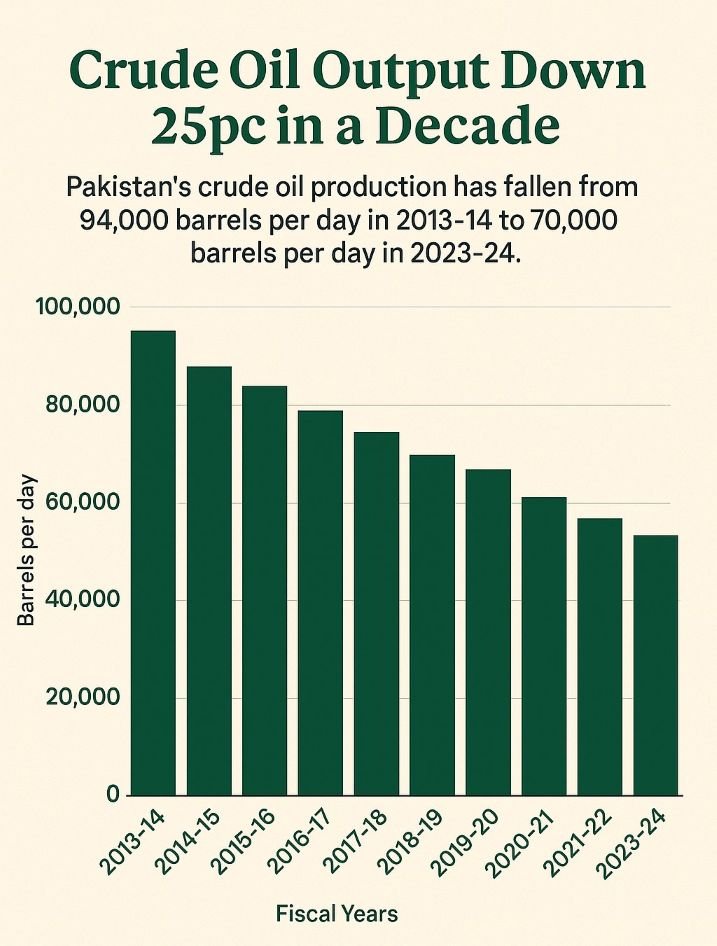
ISLAMABAD, Nov 6 (INP-Wealth Pakistan): Pakistan’s crude oil production has dropped by one-quarter over the past decade despite minor annual gains, as the country’s reserves near exhaustion with less than ten years of supply remaining at the current extraction rate.

Production inches up but remains weak

In fiscal year 2023-24, crude oil production increased by about two percent from the previous year due to limited new discoveries and better recovery from mature fields. However, overall output stayed restricted, reflecting low exploration activity and limited upstream investment.

Reserve base and regional distribution

According to the Pakistan Energy Market Review 2025 by Renewables First, Pakistan’s proved and probable reserves, or 2P reserves, stood at 1,304 million barrels by the end of FY24, up six percent from 1,229 million barrels a year earlier. The marginal increase came mainly from new exploration in Sindh and Khyber Pakhtunkhwa. Sindh held 44 percent of total reserves, Punjab 35 percent, and Khyber Pakhtunkhwa 16 percent.

Fields nearing exhaustion

Cumulative production had reached 81 percent of the total 2P reserves by June 2024, showing the depletion of Pakistan’s mature fields. The reserves-to-production ratio slightly improved to 9.4 years in FY24 from 7.6 years a year earlier, mainly due to slower output instead of significant new reserves. Without major new finds, the country’s current reserves could be exhausted within a decade.

Long-term decline in output

Average production during FY24 stood at around 70,000 to 71,000 barrels per day, roughly 3.5 million tonnes of oil equivalent. Although marginally higher than the previous year, this level remains far below FY15’s 94,000 barrels per day. The steep decline reflects chronic issues in Pakistan’s upstream petroleum sector, including investor uncertainty, foreign exchange shortages, and slow regulatory approvals.

Exploration slowdown and investor retreat

The report said limited exploration activity and the aging of key reservoirs have curbed domestic output. Several major fields in southern Sindh and central Punjab have passed their production peaks. Many foreign companies have scaled back operations because of delays in licensing, security challenges, and unattractive fiscal returns.

Imports fall amid weaker demand

Crude oil imports declined for the second straight year, mirroring reduced refinery demand and lower consumption of petroleum products. Pakistan imported 8.5 million tonnes of oil equivalent in FY24, down from 11.7 Mtoe in FY22, a drop of 24 percent in two years. Petroleum product imports also fell 18 percent to 7.1 Mtoe. The contraction eased external pressure but mainly reflected weak economic activity rather than domestic substitution.

Refinery performance and challenges

Refineries processed 12 Mtoe of crude oil in FY24, up 11 percent from the previous year, with 71 percent imported and 29 percent locally produced. Output remained dominated by high-speed diesel, furnace oil, and motor spirit, which made up 85 percent of production. The refining sector continues to struggle with outdated technology, narrow margins, and low investment in capacity upgrades.

Structural risks and policy gaps

The temporary rebound in refinery utilization cannot offset the long-term decline in the sector, which threatens energy security and raises reliance on imported fuels. The depletion of reserves and dependence on imports expose the economy to global price shocks and exchange-rate swings.

Need for urgent policy reforms

Renewables First stressed that reversing the production decline requires urgent reforms, including improved fiscal incentives, transparent licensing, and technology upgrades to attract new investors. Without these measures, Pakistan’s crude oil base will keep shrinking, further deepening dependence on imported energy and weakening long-term energy stability.

Digital Fraud and Pakistan’s Cashless Ambition

0

Pakistan is rapidly adopting digital payment systems to modernize its economy and promote financial inclusion. But rising incidents of digital fraud in Pakistan are undermining efforts to build a secure, cashless future.

Growing Digital Transactions and Security Concerns

According to the State Bank of Pakistan (SBP), the country’s digital infrastructure now supports 226 million bank accounts and 46 million RAAST IDs nationwide. The government aims to fully digitize payments by next year.
However, the financial sector warns that cybercrime is growing faster than safeguards. The Global State of Scams Report 2025 estimates that digital fraud costs Pakistan’s economy around $9.3 billion annually.

“When customers lose money or confidence in online systems, they revert to cash. This weakens trust and slows the adoption of digital wallets and mobile banking,” said Nazish Ali, Chief Executive Officer of Apna Microfinance Bank, in an interview with Wealth Pakistan.

Common Types of Digital Fraud

Ali explained that the most common cybercrime techniques include phishing, smishing, and vishing, which deceive users into sharing credentials or one-time passwords through fake emails, text messages, or calls.
Fraudsters also conduct SIM-swapping to intercept OTPs and gain access to bank accounts. ATM and debit card skimming remains widespread, enabling criminals to clone cards and steal data from terminals.

Hackers exploit weaknesses such as exposed admin portals, weak authentication, and insecure third-party links to execute unauthorized transfers. “Scammers even compromise banks’ internal systems and move funds to mule accounts before withdrawing cash through ATMs,” Ali noted.

Gaps in Cybersecurity Defenses

Pakistan’s regulatory environment is improving. The SBP has issued security guidelines for banking apps, introduced mandatory incident-reporting rules, and strengthened system controls. The Pakistan Banks Association and 1LINK have launched awareness campaigns to educate consumers.
Yet, major gaps remain in telecom security, customer education, and real-time monitoring, Ali cautioned.

Experts Call for Joint Action

Cybersecurity experts agree that enforcement remains weak. Pakistan’s cybercrime units are under-resourced and lack advanced technical expertise.
“Hackers exploit vulnerabilities, human errors, and regulatory loopholes,” said Attique Ahmad, a Lahore-based cybersecurity consultant. “Fear of fraud keeps many consumers and merchants dependent on cash.”

He added that several banks still run outdated core banking platforms without robust encryption, making them vulnerable to hacking. Insider leaks are also rising, with cases of employees selling customer data on the dark web.
Fraudsters have even launched fake apps imitating JazzCash, Easypaisa, and other mobile banking platforms to steal credentials — a major threat to branchless banking.

The Way Forward

Experts emphasize that combating digital fraud in Pakistan requires collective action by the SBP, commercial banks, telecom operators, and consumers.
Without stronger cybersecurity measures, awareness campaigns, and real-time monitoring systems, Pakistan’s dream of becoming a cashless economy may face serious setbacks.