
Home Blog Page 17

Chilies cultivation rises slightly in Pakistan but misses 2025–26 targets

0

ISLAMABAD, Oct 29 (Wealth Pakistan) – Pakistan’s chilies crop recorded marginal growth in both area and production during 2025–26, but yield and output remained below official targets, according to an official document available with Wealth Pakistan.

The document shows that while the overall cultivation area of chilies — a key cash crop grown across all provinces — expanded slightly compared with the previous year, productivity gains were limited and the national targets were not met.


Area and production trends

The area under chilies increased by 1.1 percent to 49,500 hectares in 2025–26, up from 49,000 hectares last year. Production edged up 0.5 percent to 114,400 tons compared with 113,800 tons a year earlier. However, the national average yield slipped by 0.6 percent to 2,312 kilograms per hectare from 2,325 kilograms per hectare previously.

Sindh remained the leading producer, contributing 85,300 tons from 35,700 hectares — almost unchanged from last year’s 35,600 hectares. Punjab followed with 17,800 tons, down 1.1 percent from 18,000 tons, despite a 1.5 percent increase in sown area to 6,900 hectares.

Balochistan’s production rose 2.9 percent to 10,500 tons on a 3.2 percent expansion in area from 6,300 hectares to 6,500 hectares. Khyber Pakhtunkhwa (KPK) posted a sharp 56 percent increase in both area and production, though its share in national output remained minimal at 800 tons.


Provincial yield performance

Yield patterns varied across provinces. Punjab’s yield fell 2.5 percent to 2,579.7 kilograms per hectare from 2,647.1 kilograms per hectare a year ago, while Balochistan and KPK maintained stable yields. Sindh, the largest producer, sustained a high average yield of 2,389.4 kilograms per hectare.

Despite these steady results, the overall national crop fell well short of government targets for the current fiscal year. Against the Federal Committee on Agriculture’s (FCA) target of 54,400 hectares, only 49,500 hectares were cultivated — about 9 percent less. Production was estimated at 114,600 tons compared to the official target of 146,400 tons, reflecting a shortfall of 21.7 percent.

The national average yield of 2,316.2 kilograms per hectare also remained 13.9 percent below the FCA’s target of 2,690.4 kilograms per hectare.


Regional performance against targets

Punjab and Khyber Pakhtunkhwa fell slightly short of their official goals. Punjab achieved 90 percent of its production target and 87.3 percent of its area target, while KPK missed its goals by 22 percent in area and 21 percent in production.

In contrast, Balochistan outperformed, exceeding its area and production targets by 8.3 percent and 11.1 percent respectively, supported by a 2.6 percent improvement in yield.

Sindh, which accounts for over 70 percent of the country’s chilies output, underperformed — missing its production target by 26.4 percent. However, it maintained consistent yield levels compared to the previous year, reflecting strong productivity despite area and output shortfalls.

China disburses $2 million for economic project in Punjab

0

ISLAMABAD, Oct 29 (Wealth Pakistan) – China has disbursed $2 million to Pakistan in September 2025 for the Economic and Technical Cooperation Project in Punjab, according to the Monthly Foreign Economic Assistance Report released by the Ministry of Economic Affairs. The assistance reflects Beijing’s continued financial engagement in Pakistan’s provincial development and institutional capacity-building programs.

The project, funded through a Chinese grant, aims to strengthen Pakistan’s technical infrastructure, enhance institutional linkages, and promote development cooperation between the two countries. The latest disbursement underscores China’s commitment to practical, province-level initiatives under its bilateral framework with Pakistan, beyond the major infrastructure ventures associated with the China–Pakistan Economic Corridor (CPEC).


Continued Chinese assistance

During September 2025, China’s total disbursements to Pakistan amounted to approximately $2 million, while cumulative assistance for the first quarter of FY2025–26 (July–September) reached $9.75 million, combining both grants and loans.

In addition to the Punjab project, China continued funding reconstruction and rehabilitation programs across several regions. These included rebuilding fully damaged schools in Bara District, Khyber Pakhtunkhwa, valued at $4.47 million; construction of housing projects in Balochistan worth $6 million; and establishment of the New Generation Geodetic Datum of Pakistan under the Defense Division, amounting to $1.08 million.


Broader development partnership

China remains engaged in multiple large-scale projects of national significance, including the relocation of the Karakoram Highway (Thakot–Raikot section), establishment of the Pakistan Space Center (SUPARCO), and the creation of the China–Pakistan Joint Research Centre on Earth Sciences at Quaid-e-Azam University.

These initiatives form part of a broader bilateral partnership focused on modernizing Pakistan’s infrastructure, enhancing technological capacity, and fostering scientific research collaboration.


Support for financial stability

China’s contribution to Pakistan’s financial stability also extends beyond project aid. The country maintains a SAFE China Deposit of $4 billion, a vital component of Pakistan’s external financing structure that supports macroeconomic stability and the balance of payments.

The latest disbursement for Punjab’s Economic and Technical Cooperation Project underscores Beijing’s diversified engagement strategy, reflecting its commitment to both grassroots development and national-scale investments.

Analysts see these flows as a sign of Pakistan’s enduring partnership with Beijing, emphasizing shared objectives of sustainable growth, regional connectivity, and economic cooperation.

Material shortage hits carpet industry amid Torkham border closure

0

LAHORE, Oct 29 (Wealth Pakistan) – Pakistan’s carpet industry is facing growing material shortages after the closure of the Torkham border disrupted supply chains and delayed shipments from Afghanistan, leaving manufacturers struggling to maintain production schedules.

Different styles of handmade carpets arrive from Afghanistan in semi-finished form and are given final touches in Pakistan before export. Pakistani exporters, directly connected with Afghan traders and producers, are finding it difficult to secure essential materials needed to fulfill existing international orders.

Exporters warned that if the situation at the Torkham border remains tense, they could start losing export contracts within a few weeks.


Exporters voice concern

Talking to Wealth Pakistan, Malik Abdul Latif, Patron-in-Chief of the Pakistan Carpet Manufacturers and Exporters Association, said that if the current disruption continues indefinitely, it could be damaging because certain goods will stop arriving altogether. Some products, including Khurjin and Sultani-design carpets, come exclusively from Afghanistan.

He added that every country has its own culture, design, and tradition, while Pakistan’s own patterns such as Mohri, Jaaldar, and Sutri are unique in their craftsmanship. Afghan customers, when they visit Pakistan, find a full range of materials in one place, whereas foreign buyers often avoid Afghanistan due to security and banking constraints.

Latif said only shipments routed to Turkey through Iran are currently feasible. Sending containers directly from Afghanistan to the United States or Europe is difficult due to longer transit times and higher shipping costs. Both Pakistan and Afghanistan, he noted, are deeply interconnected, and the situation should improve in the days ahead.


National interest and local resilience

Emphasizing the national perspective, he said Pakistan’s security and integrity come first. Trade is secondary, and the business community stands with the country’s armed forces in protecting national interests.

He added that the local segment of Pakistan’s carpet industry has not yet been affected. Domestic manufacturers are using locally sourced wool and materials, ensuring production continuity. However, he acknowledged that imports from Afghanistan remain temporarily halted and expressed confidence that the trade route would reopen soon.

He said that most required supplies had already arrived in Pakistan about fifteen days before the border closure, which minimized immediate disruption. Once the border reopens, material flow will resume normally, he added.


Potential export losses

Another exporter, Muhammad Ashraf, told Wealth Pakistan that if the situation persists long-term, up to 30 percent of Pakistan’s carpet exports could be affected.

He noted that the industry remains stable for now, as raw wool is imported directly from Siberia and local facilities handle all dyeing, washing, and finishing processes. Banking and logistics operations are fully functional in Pakistan, while Afghanistan is suffering from limited weaver and labor income opportunities.

Ashraf warned that if the border closure extends beyond November, both countries could experience broader economic repercussions, but reopening within weeks would prevent any lasting damage.

Govt mobilises Rs 2.03tr through T-bills, Rs 205bn via bonds

0

ISLAMABAD, Oct 29 (Wealth Pakistan) – The Government of Pakistan has raised Rs 2.03 trillion through T-Bills and Rs 205 billion via bonds, reflecting continued investor confidence in domestic debt instruments, according to the latest data released by the State Bank of Pakistan (SBP).

The SBP conducted the auction for 1-month, 3-month, 6-month, and 12-month Market Treasury Bills (MTBs) on October 29, 2025, with settlement due on October 30. The auction received bids worth Rs 2.13 trillion, out of which Rs 2.03 trillion were accepted.


Strong investor interest

The 1-month tenor attracted the highest participation, recording a realized value of Rs 855.84 billion against a face value of Rs 863.15 billion. The 12-month bills followed with Rs 637.87 billion, while the 3-month and 6-month papers fetched Rs 285.63 billion and Rs 252.62 billion, respectively.

The cut-off yields were reported at 11.0003 percent for 1-month, 11.0489 percent for 3-month, 11.0488 percent for 6-month, and 11.3498 percent for 12-month papers. Weighted-average yields ranged between 10.93 percent and 11.28 percent, showing stability across short-term maturities.

Including non-competitive bids worth Rs 245.50 billion, the total acceptance reached Rs 1.05 trillion. The 12-month tenor dominated the auction, accounting for Rs 570.37 billion of the accepted amount.


Sustained demand for long-term debt

Meanwhile, in the semi-annual auction for 10-year Pakistan Investment Bonds – Floating Rate (PFL), the government raised Rs 205.88 billion. The auction, also held on October 29, 2025, attracted bids totaling Rs 1.01 trillion within a price range of 95.0287 to 92.1560.

Out of these, Rs 205.88 billion were accepted at a cut-off price of 95.0012. The realized amount from competitive bids stood at Rs 190.02 billion, while non-competitive bids contributed Rs 5.88 billion. Including accrued interest, the total realized amount reached Rs 196.65 billion.


Market outlook

The results indicate strong participation from primary dealers and institutional investors in both short- and long-term maturities. Experts say this trend highlights a stable outlook for the domestic debt market and investor trust in government securities.

Economists also believe that the robust response shows confidence in the SBP’s current monetary policy stance, aimed at maintaining price stability and ensuring smooth financing for fiscal needs.

Pakistan-Afghanistan talks in Istanbul collapse

0

ISLAMABAD, Oct 29 (Wealth Pakistan) – Talks between Pakistan and the Afghan Taliban regime in Istanbul have collapsed after four days of negotiations failed to deliver assurances from the Afghan side to curb cross-border terrorism, according to a statement released by Inter-Services Public Relations (ISPR) released early Friday.

The dialogue was held at the request of Qatar and Türkiye and followed earlier meetings in Doha. Pakistan said the talks focused on a single agenda: convincing the Afghan Taliban regime to prevent militant groups from using Afghan territory as training and launch bases for attacks inside Pakistan.

According to Pakistan, Islamabad presented “sufficient and irrefutable” evidence proving the involvement of India-backed terrorist groups, including the Tehreek-e-Taliban Pakistan (TTP) and the Baloch Liberation Army (BLA), in attacks launched from Afghan soil. The Afghan side and host countries acknowledged the evidence, but the Taliban delegation gave no commitment to act.

Afghan Side Avoids Core Issue

Pakistan stated that instead of addressing the core concern, the Afghan Taliban resorted to blame-shifting and evasion. The delegation repeatedly deviated from the main issue of cross-border terrorism. Pakistan said the talks failed because the Afghan regime refused to take credible steps against militants operating in Afghanistan.

Islamabad expressed gratitude to Qatar and Türkiye for their sincere facilitation efforts. Both countries tried to convince the Afghan leadership to stop using proxy groups as leverage against Pakistan. However, despite those efforts, the dialogue ended without any progress or workable solution.

Pakistan Reiterates Commitment to Peace

Pakistan’s statement blamed the deadlock on the Afghan regime’s continued tolerance of a “war economy.” It said the Taliban leadership shows little responsibility toward the Afghan people and is more focused on maintaining control through instability.

Islamabad reaffirmed that Pakistan has always advocated peace and stability in Afghanistan and has made major sacrifices for that goal. Despite these efforts, Pakistan said its patience has reached its limit after years of cross-border attacks that have killed security personnel and civilians.

Security to Remain Top Priority

The government stressed that the security of its people remains its highest priority. Pakistan will continue to take all possible measures to protect its citizens from terrorism. Officials said the government will employ every available resource to dismantle terrorist networks, eliminate sanctuaries, and punish their abettors and supporters.

Pakistan has engaged the Afghan Taliban regime in multiple rounds of talks in recent years. The failure of the Istanbul dialogue now threatens to deepen tensions between the two neighbours and complicate regional stability efforts.

Bright bedroom lights at night may raise risk of heart disease

0

WASHINGTON, Oct 28 (CNN) – Sleeping in brightly lit rooms may do more than just disturb rest — it could significantly increase the risk of developing cardiovascular disease, the world’s leading cause of death, according to new research published in the journal JAMA Network Open.

The study, based on nearly 89,000 participants from the UK Biobank, found that people exposed to high light intensity during sleep hours faced substantially higher risks of heart failure, coronary artery disease, and stroke compared to those who slept in darker environments.


Sleeping in bright light linked to heart failure and stroke

Participants who slept under the brightest nighttime conditions — equivalent to keeping overhead lights on — had a 56% greater risk of heart failure, a 32% higher risk of coronary artery disease, and a 28% greater risk of stroke.

The findings suggest that even moderate nighttime light exposure could disrupt the body’s circadian rhythms, which regulate sleep cycles, hormone release, and cardiovascular function.

“Light can suppress melatonin, a hormone that helps the body prepare for sleep,” said Dr. Daniel Windred of Flinders University, the study’s co-author. “Reducing light exposure at night might therefore support not just better rest but better heart health.”


Tracking the impact of light exposure

Researchers analyzed more than 13 million hours of nighttime light data collected from wrist-worn devices between 12:30 a.m. and 6 a.m. Participants were then followed for about nine years to monitor cardiovascular outcomes.

The average age of participants was 62, and none had a prior history of heart disease. The researchers adjusted their findings for factors such as smoking, alcohol intake, physical activity, diet, and shift work — yet the association between nighttime light and heart disease risk remained strong.

Women were found to be more susceptible to heart failure and coronary artery disease, while younger individuals showed higher risks for atrial fibrillation (A-fib) — an irregular heart rhythm that can lead to stroke.


Circadian rhythm disruption and cardiovascular stress

Circadian rhythms — 24-hour biological cycles present in nearly every cell — are sensitive to light signals. Artificial light at night can confuse the body’s internal clock, leading to increased blood pressure, higher blood sugar, and inflammation, all of which are risk factors for cardiovascular disease.

“It’s possible that the body perceives nighttime light as a stressor, triggering hormonal and metabolic responses that elevate cardiovascular risk,” said Dr. Julio Fernandez-Mendoza, director of behavioral sleep medicine at Penn State Health, who was not involved in the study.

The study also noted that exposure to bright morning light — soon after waking — correlated with better heart health, suggesting that maintaining a healthy light–dark cycle may be essential for cardiovascular wellbeing.


Practical tips for protecting heart and sleep health

Experts recommend reducing artificial light exposure at night to protect both sleep and cardiovascular function.

“If turning the lights off isn’t possible, use dim or warm lighting instead of bright overhead bulbs,” Dr. Windred advised. “Avoid glowing alarm clocks, and consider blackout curtains or sleep masks to minimize disruption.”

Limiting screen use before bed and turning off household lights at least four hours before sleeping can also help restore natural melatonin production.


More research needed

Despite its scale, the study acknowledges limitations. It tracked light exposure for only one week, lacked ethnic diversity (97% of participants were White), and did not measure sleep quality directly. Researchers say further studies are needed to understand how reducing nighttime light could help lower cardiovascular risk across different populations.

Still, scientists believe the results strengthen evidence linking environmental light exposure to long-term health outcomes.

“Our research highlights how something as simple as light at night may influence one of the leading causes of death worldwide,” Windred said. “Small changes in sleep environments could yield big public health benefits.”

Microsoft, OpenAI strike $500 billion deal to reshape AI partnership

0

WASHINGTON, Oct 28 (Reuters) – Microsoft and OpenAI have finalized a landmark restructuring agreement that transforms the ChatGPT developer into a public benefit corporation (PBC) valued at $500 billion — a move that gives OpenAI greater independence while maintaining deep operational ties with Microsoft.

The deal, announced jointly by both companies on Tuesday, marks one of the largest corporate valuations in the tech industry and redefines the governance model of one of artificial intelligence’s most influential players.


OpenAI gains new autonomy under public benefit structure

Under the new framework, OpenAI will operate as OpenAI Group PBC, a structure designed to balance commercial growth with its stated mission of ensuring artificial intelligence benefits humanity. The reorganization effectively removes long-standing restrictions on OpenAI’s fundraising and business operations that were imposed under its 2019 agreement with Microsoft.

That earlier deal gave Microsoft extensive rights to OpenAI’s technology in exchange for billions of dollars in cloud computing services — a partnership that fueled OpenAI’s rapid expansion but limited its ability to attract new investors.

“The nonprofit remains in control of the for-profit, and now has a direct path to major resources before AGI arrives,” said Bret Taylor, board chair of the OpenAI Foundation, in a blog post announcing the restructuring.


Microsoft retains major stake and cloud partnership

Despite the restructuring, Microsoft will retain a 27 percent equity stake in the new OpenAI Group PBC, valued at about $135 billion. The software giant, which has invested $13.8 billion in OpenAI to date, now stands to gain nearly a tenfold return on its original investment.

The two firms also extended their partnership through 2032, including a massive $250 billion cloud services agreement under which OpenAI will purchase Azure computing resources. In exchange, Microsoft will give up its “first refusal” rights for future computing deals — granting OpenAI the flexibility to engage with other vendors.

Microsoft’s shares rose 2.5 percent following the announcement, pushing its market capitalization back above the $4 trillion mark.


No equity for Altman, no IPO plans

OpenAI CEO Sam Altman will not receive equity in the restructured company, reversing earlier discussions that considered offering him shares. The company also confirmed that it has no immediate plans for an initial public offering.

Altman, who has led OpenAI through a period of explosive growth driven by ChatGPT’s popularity, said the PBC structure ensures that the company’s development remains aligned with its long-term mission while providing financial flexibility.

OpenAI currently serves more than 700 million weekly users, cementing its position as the world’s most widely recognized AI platform.


Addressing governance, safety, and AGI oversight

The deal includes new governance mechanisms to address one of the most debated questions in AI — how to verify the arrival of artificial general intelligence (AGI). An independent panel will now be responsible for confirming OpenAI’s claims if and when it achieves AGI, a milestone defined as human-level cognitive performance in machines.

Analysts say the new structure aims to strike a balance between innovation, accountability, and safety.

“OpenAI still faces scrutiny around transparency and data governance,” said Adam Sarhan, CEO of 50 Park Investments. “But this structure provides a clearer path forward for innovation and oversight.”

Gil Luria, head of technology research at DA Davidson, said the deal resolves a long-standing tension in OpenAI’s structure. “It clarifies the ownership rights between OpenAI and Microsoft, paving the way for future fundraising and collaboration,” he added.


Expanding horizons beyond AI software

In addition to its AI research, OpenAI continues to broaden its technological footprint. Earlier this year, the company acquired io Products — the startup founded by former Apple design chief Jony Ive — in a $6.5 billion deal. The acquisition is seen as a step toward integrating AI with next-generation consumer hardware.

Microsoft clarified that it will not hold any rights to hardware produced by OpenAI under the new arrangement.

As OpenAI transitions into its new phase, the restructured partnership with Microsoft is expected to redefine the dynamics of the global AI industry — balancing commercial momentum with public accountability in the race toward advanced artificial intelligence.

This news was originally published by Reuters.

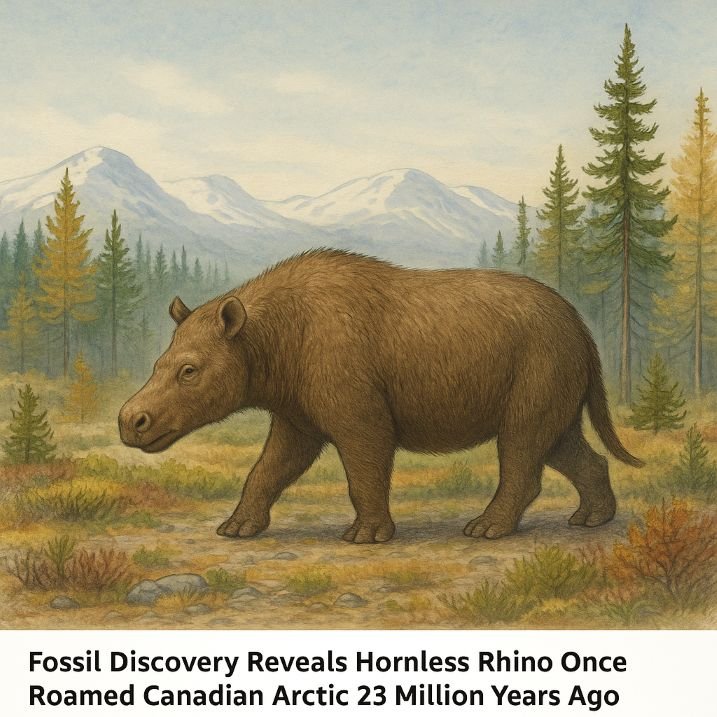
Fossil discovery reveals hornless rhino once roamed Canadian Arctic 23 million years ago

0

LONDON, Oct 28 (Reuters) – Scientists have discovered the fossilized remains of a previously unknown rhinoceros species that once lived in the Canadian High Arctic about 23 million years ago — a region that, while warmer than today, still endured months of snow and darkness.

The animal, named Epiaceratherium itjilik or “polar rhino,” lived during the early Miocene epoch and represents the first known rhino species to inhabit such high latitudes. The fossil was unearthed on Devon Island in Nunavut, Canada, within Haughton Crater — one of the world’s northernmost meteor impact sites.


Arctic fossil sheds light on mammal evolution

Researchers found roughly 75 percent of the animal’s skeleton preserved in permafrost, providing rare insights into how large mammals adapted to ancient Arctic ecosystems. Measuring about one meter tall at the shoulder, the polar rhino was comparable in size to today’s Indian rhinoceros but lacked a horn.

“Devon Island during the Miocene was much more temperate and forested, quite unlike the polar desert that exists there today,” said Danielle Fraser, head of palaeobiology at the Canadian Museum of Nature and lead author of the study published in Nature Ecology & Evolution.

Fraser said summers were mild while winters brought snow and long periods of darkness — similar to the modern climate of southern Ontario or northern New York. “It remains a mystery how animals like a rhino survived, though modern mammals use hooves and antlers to dig through snow for food,” she added.


A temperate Arctic forest teeming with life

The fossilized pollen and plant remains from the site suggest that the rhino lived in a forested environment dominated by pines, spruce, birch, larch, and alder. The rhino’s narrow muzzle indicates it fed primarily on the leaves of trees and shrubs — similar to modern browsing species.

Fraser said the Arctic may have played a more significant role in mammalian evolution than previously thought. “We often think about the tropics as biodiversity centers, and they are,” she explained. “But these discoveries show that the Arctic was also crucial in shaping mammal evolution.”

The researchers believe Epiaceratherium itjilik may have had a thick coat of fur to endure the freezing winters — much like the woolly rhinoceros that roamed Eurasia during the Ice Age, though the two species were not closely related.


Genetic insights and migration mystery

In a related study published in July, scientists extracted ancient proteins from the rhino’s tooth enamel — a major breakthrough since proteins can survive far longer than DNA. The analysis helped clarify the animal’s place in the rhinoceros family tree, showing that its closest relatives lived in Europe, the Middle East, and southwestern Asia.

This finding suggests that rhino ancestors crossed from Europe into North America via Arctic land bridges that remained passable millions of years longer than previously believed. “Our study shows rhinos were crossing for at least 20 million years longer than we thought,” Fraser said.

Geological evidence supports this, indicating that routes over Iceland and Greenland, as well as from Finland through Svalbard, remained intermittently open during the Miocene — providing migration corridors between continents.


Expanding the known range of ancient rhinos

The discovery expands scientists’ understanding of how adaptable early rhinos were and reshapes theories about Arctic ecosystems in prehistoric times. Other fossils recovered from the same site include those of Puijila darwini, an early seal species with feet rather than flippers — further evidence of evolutionary transition in the region.

Rhinos first appeared about 48 million years ago and once ranged across every continent except South America and Antarctica. While only five species survive today, over 50 are known from the fossil record.

“The polar rhino discovery reminds us that ancient ecosystems were dynamic, interconnected, and resilient,” Fraser said. “The Arctic was not a frozen wasteland — it was a thriving cradle of evolution.”

This news was originally published by Reuters.

Trump, Japan’s new PM seal rare earths deal in first summit

0

TOKYO, Oct 28 (Reuters) – U.S. President Donald Trump and Japan’s new Prime Minister Sanae Takaichi on Tuesday announced a major agreement on critical minerals and rare earths, while pledging deeper economic and security cooperation during their first bilateral meeting in Tokyo.

The talks — marked by warm personal gestures and symbolic tributes to former Prime Minister Shinzo Abe — also saw both leaders highlight plans for expanded Japanese investment in the U.S. and Tokyo’s accelerated military buildup amid regional security concerns.


New era in Japan-U.S. relations

Takaichi, Japan’s first female prime minister and a protégé of the late Abe, used her debut summit with Trump to reinforce the continuity of Tokyo’s strategic partnership with Washington. She pledged to fast-track defence spending to 2 percent of GDP and reaffirmed Japan’s commitment to shared Indo-Pacific security goals.

“Everything I know from Shinzo and others tells me you will be one of the great prime ministers,” Trump said during their talks at Tokyo’s Akasaka Palace. “Becoming Japan’s first female prime minister is a big deal.”

According to officials, the two sides also discussed cooperation on energy, artificial intelligence, and industrial supply chains. A joint statement outlined plans for Japanese investments of up to $400 billion in U.S. technology and infrastructure projects.

Earlier this year, Tokyo pledged $550 billion in loans, guarantees, and strategic U.S. investments as part of a broader arrangement that secured a reprieve from American import tariffs.


Rare earths deal aims to cut China dependence

A key outcome of the summit was a new deal to strengthen supply chains for critical minerals and rare earth elements, essential for electronics and defence production. Both sides emphasized the need to diversify away from China’s dominant position in global supply chains.

Trump praised Japan for “stepping up to help secure the world’s energy and technology future,” adding that the agreement marked “a new chapter in U.S.-Japan economic leadership.”

Takaichi said Japan would boost purchases of U.S. defence equipment and expand industrial cooperation. “This is about ensuring stability, security, and technological self-reliance for both our nations,” she said.


Symbolism and legacy diplomacy

Throughout the visit, Takaichi sought to evoke Abe’s legacy, presenting Trump with the late leader’s golf putter encased in glass, a signed golf bag from Japanese major winner Hideki Matsuyama, and a gold-leaf golf ball. Trump later met Abe’s widow, Akie Abe, who gifted him a painting emblazoned with the word “PEACE.”

Abe, assassinated in 2022, was the first foreign leader to meet Trump after his 2016 election victory, and the two had forged an unusually close rapport over multiple rounds of golf in the U.S. and Japan.

Over a lunch featuring American beef and rice alongside vegetables from Takaichi’s hometown of Nara, the Japanese leader presented Trump with a map showcasing major investments by Japanese companies since his last visit in 2019. Firms including Mitsubishi Heavy Industries, SoftBank, Hitachi, Murata, and Panasonic were listed among those planning new U.S. ventures.

Trump announced that Toyota would invest $10 billion to expand its auto manufacturing operations in the U.S., and said Japan planned to import Ford’s iconic F-150 pickup trucks — rare on Japanese roads.


Domestic and regional dimensions

Analysts said Takaichi’s strategic alignment with Trump could help strengthen her politically at home, where her coalition remains two seats short of a lower house majority. Her firm stance on defence and continuity with Abe’s foreign policy may bolster her image as a strong leader navigating uncertain global dynamics.

Trump and Takaichi also discussed Japan’s long-standing issue with North Korea over citizens abducted in the 1960s and 1970s. After meeting families of the abductees, Trump reaffirmed U.S. support, saying Washington was “with them all the way.”


Naval visit underscores defence ties

Later in the day, Trump and Takaichi flew by helicopter to the U.S. aircraft carrier George Washington, docked at the Yokosuka naval base. Addressing 6,000 U.S. sailors, Trump praised Japan’s military cooperation and announced that deliveries would soon begin for Japan’s long-awaited order of U.S. missiles for its F-35 fighter jets.

“This woman is a winner,” Trump told the crowd, ushering Takaichi to the stage as a show of alliance unity.

Japan currently hosts the largest concentration of U.S. military forces outside American territory, a central pillar of the bilateral security framework.


Toward a trade thaw and regional diplomacy

Trump’s five-day Asia tour — his longest foreign trip since returning to office in January — began in Malaysia and will conclude with a planned meeting in South Korea with Chinese President Xi Jinping. U.S. officials said the encounter aims to ease trade tensions and signal stability in a region marked by growing geopolitical rivalry.

As the day ended, Trump met with business leaders in Tokyo, engaging in an animated exchange with SoftBank CEO Masayoshi Son about golf — before delivering a wide-ranging speech touching on the economy, sports, and U.S. domestic politics.

Freeman’s 18th-inning homer lifts Dodgers over Blue Jays in historic World Series Marathon

0

LOS ANGELES, Oct 28 (Reuters) – Freddie Freeman hit a dramatic walk-off home run in the 18th inning to give the Los Angeles Dodgers a thrilling 6–5 win over the Toronto Blue Jays in Game Three of the World Series — a contest that will go down as one of the longest and most dramatic in Major League Baseball history.

The epic duel, lasting nearly six hours and 40 minutes, tied the record for the longest World Series game ever played by innings, matching the 18-inning battle between the Dodgers and the Boston Red Sox in 2018.

“It’s one of the greatest World Series games of all time,” Dodgers manager Dave Roberts said afterward. “I’m spent emotionally … fortunately for the Dodgers, we’ve got Freddie Freeman on our team.”


Freeman makes World Series history

Freeman’s towering homer off reliever Brendon Little electrified the Dodger Stadium crowd and sealed a game that tested the limits of endurance for both teams. The Dodgers’ star first baseman also became the first player in MLB history to hit multiple walk-off home runs in World Series play.

Freeman had achieved a similar feat last season with a walk-off grand slam against the New York Yankees. His latest performance places him among an elite group of only four players to record multiple postseason walk-off homers.

“I’m just trying to help the team win,” Freeman said after the game. “To do it here, in front of our fans, in a game like this — it’s something special.”


Ohtani dazzles with record-setting performance

Shohei Ohtani continued his remarkable postseason run, reaching base nine times — a new Major League Baseball postseason record. The Japanese two-way superstar hit two home runs, two doubles, and drew five walks, four of them intentional, as the Blue Jays’ pitchers struggled to contain him.

“I get it. He’s the best player on the planet,” Roberts said, smiling. Ohtani, who is scheduled to pitch in Game Four on Tuesday, tied Corey Seager’s Dodgers record of eight home runs in a single postseason.

“What matters is that we won,” Ohtani said after the marathon victory. “I just want to get some sleep and get ready for tomorrow.”


Rookie pitcher seals the win

Rookie right-hander Will Klein became an unlikely hero, pitching four shutout innings in relief to earn the win. He was the Dodgers’ 10th pitcher of the night, closing the door on multiple Blue Jays scoring threats in the extra innings.

“I love the way we played,” Blue Jays manager John Schneider said. “Every single player gave everything. There’s a lot to digest, but I couldn’t be prouder of the effort.”

Despite the loss, Toronto matched Los Angeles pitch-for-pitch through 17 innings before Freeman’s decisive swing. The Blue Jays’ bullpen logged more than 300 pitches in the game — a testament to the grueling nature of the contest.


A World Series classic for the ages

As the clock neared midnight, the sold-out crowd at Dodger Stadium erupted in celebration. Players from both sides embraced on the field, exhausted but aware they had been part of baseball history.

“Guys will do anything to win a championship,” Roberts said. “They’re laying it all out there, and that’s what makes nights like this unforgettable.”

The victory gives the Dodgers a 2–1 lead in the best-of-seven World Series. Game Four will see Ohtani take the mound as Los Angeles looks to push closer to its second title in three years.

This news was originally published by Reuters.