

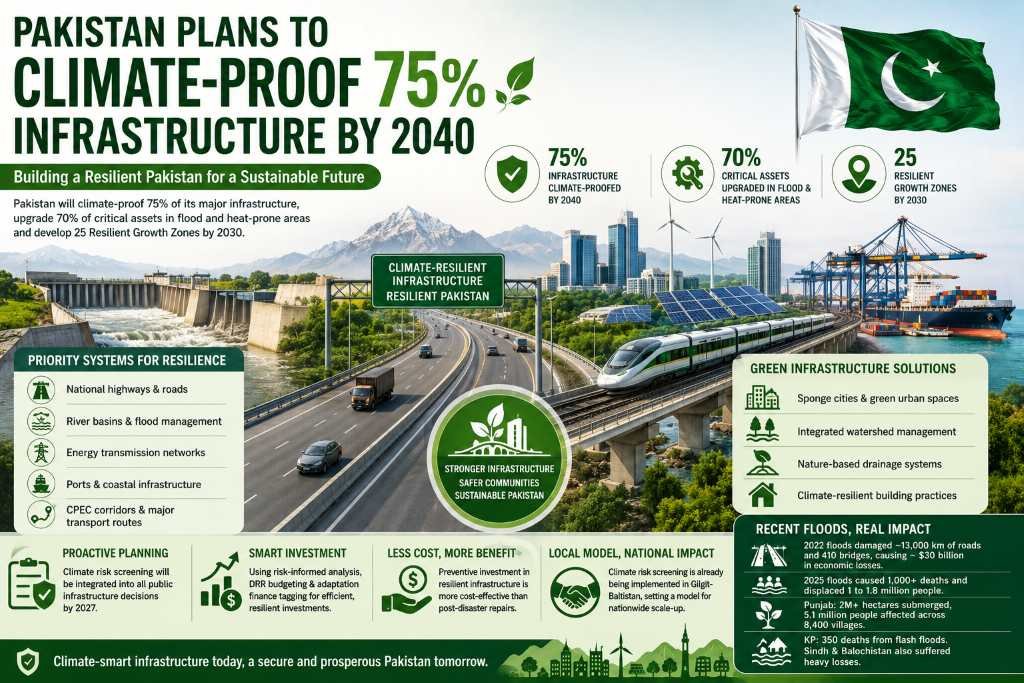

ISLAMABAD, May 05 (Wealth Pakistan): Pakistan plans to climate-proof 75% of its major infrastructure by 2040 and upgrade 70% of critical assets in flood and heat-prone areas. The country also plans to establish 25 Resilient Growth Zones by 2030 under a new climate resilience strategy.
According to a document available with Wealth Pakistan, the government wants to strengthen infrastructure against rising climate threats through climate-smart systems, stronger engineering standards, and better early warning mechanisms.
Climate risks expose infrastructure weaknesses
The document warns that Pakistan’s infrastructure remains highly vulnerable to floods, heatwaves, and other extreme weather events. Many roads, bridges, and energy systems were developed without proper climate risk assessments.
The growing frequency of climate disasters has increased pressure on public infrastructure. As a result, the government now plans to shift toward long-term climate-resilient planning.
Under the strategy, provincial governments will integrate climate vulnerability screening into all public infrastructure and investment decisions by 2027. Authorities will also make climate risk assessments and adaptation costing mandatory for all major infrastructure projects.
The document notes that a large share of Pakistan’s infrastructure lies in floodplains and heat-affected districts. However, it says the country can modernise these systems through improved planning and stronger construction standards.
CPEC routes among priority sectors
The strategy identifies national highways, river basins, ports, energy transmission networks, and major transport corridors as priority sectors for climate-resilient upgrades. It also highlights routes linked to the China-Pakistan Economic Corridor (CPEC).
The document says stronger infrastructure can reduce disaster losses, improve economic stability, and support sustainable growth.
At the same time, the government plans to expand green infrastructure solutions in urban and rural areas. These solutions include sponge cities, integrated watershed management, nature-based drainage systems, and climate-resilient building designs.
Focus on proactive climate planning
The strategy aims to institutionalise climate risk screening across all major development projects. Authorities plan to use climate risk-informed cost-benefit analysis, disaster risk reduction budgeting, and adaptation finance tagging to improve investment decisions.
The document stresses that preventive investment costs less than rebuilding after disasters. Therefore, Pakistan must move from reactive disaster response toward proactive climate planning.
Encouragingly, climate risk screening is already underway in Gilgit-Baltistan. The Aga Khan Agency for Habitat and the Aga Khan Rural Support Programme are implementing projects in collaboration with the government.
The document describes this initiative as a model that can support nationwide resilience-building efforts.
Recent floods highlight urgency
Recent climate disasters continue to highlight the need for resilient infrastructure across Pakistan.
The 2022 floods damaged nearly 13,000 kilometres of roads and 410 bridges. The disaster disrupted connectivity and caused economic losses estimated at around $30 billion.
The document also refers to flooding in 2025, which caused more than 1,000 deaths and displaced between one million and 1.8 million people.
Punjab faced severe impacts during recent floods. More than two million hectares of land went underwater, while 5.1 million people across 8,400 villages suffered losses.
Khyber Pakhtunkhwa recorded around 350 deaths from flash floods. Meanwhile, Sindh and Balochistan also suffered heavy damage to infrastructure, agriculture, and housing.
Despite these challenges, the document says climate-smart infrastructure offers Pakistan a pathway to reduce future disaster risks, protect livelihoods, and support sustainable economic development.