

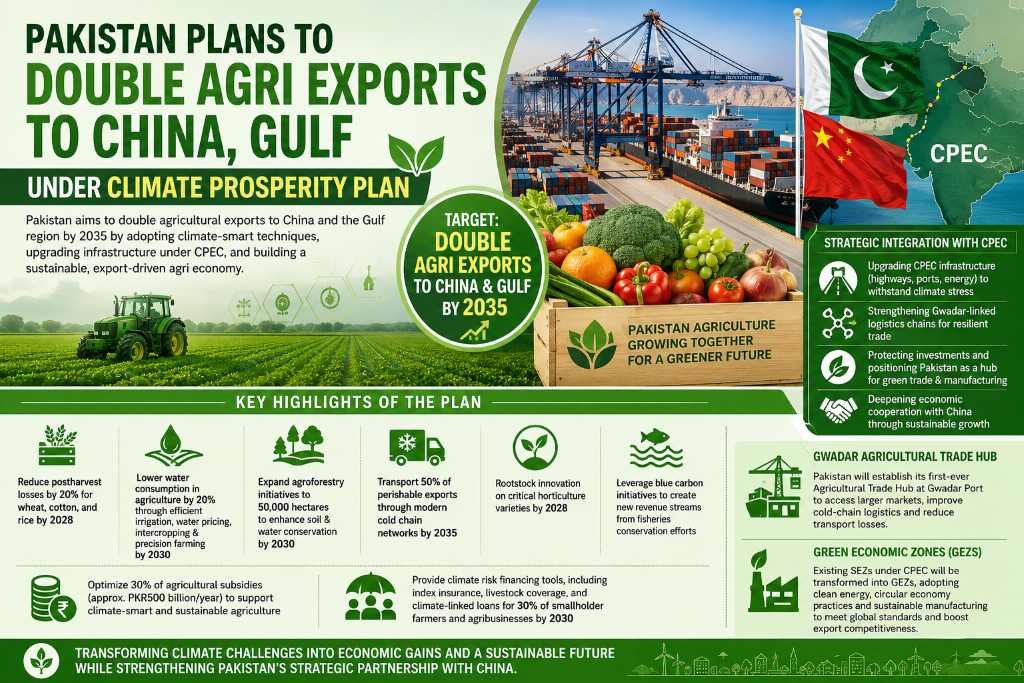

ISLAMABAD, May 05 (Wealth Pakistan): Pakistan plans to double its agricultural exports to China and the Gulf region by 2035 through climate-smart farming and green infrastructure initiatives under the newly unveiled Pakistan Climate Prosperity Plan.
According to an official document available with Wealth Pakistan, the plan represents a major policy shift that combines climate resilience, sustainable growth, and economic modernisation with the China-Pakistan Economic Corridor (CPEC). The strategy aims to strengthen infrastructure, improve export competitiveness, and attract environmentally sustainable investment.
Under the plan, Pakistan will upgrade key infrastructure linked to the CPEC, including highways, ports, and energy transmission systems, to withstand rising environmental and climate-related pressures. The government also plans to strengthen road connectivity and improve the resilience of Gwadar-linked logistics networks, which play a crucial role in Pakistan-China trade.
The document states that Pakistan will establish its first Agricultural Trade Hub at Gwadar Port to expand access to Chinese and Gulf markets. The project will focus on improving cold-chain logistics, reducing transportation losses, and increasing the efficiency of agricultural exports.
In addition, the government plans to convert existing Special Economic Zones (SEZs), many of which were developed under the CPEC framework, into Green Economic Zones (GEZs). These zones will promote clean energy use, circular economy practices, and environmentally sustainable manufacturing to help Pakistani products meet international environmental standards and improve export competitiveness in global markets, particularly China.
The plan says the integration of climate-smart policies with the CPEC will help protect strategic investments while positioning Pakistan as a regional hub for green manufacturing, sustainable trade, and climate-resilient industrial development.
Furthermore, the strategy outlines several agriculture-sector targets aimed at improving productivity and reducing environmental pressure. Pakistan plans to cut post-harvest losses of wheat, cotton, and rice by 20% by 2028 through improved storage and handling systems.
The government also aims to reduce water consumption in agriculture by 20% by 2030 through efficient irrigation systems, precision farming, intercropping, and improved water pricing mechanisms. At the same time, agroforestry initiatives will expand to 50,000 hectares to strengthen soil protection and water conservation efforts.
The document further highlights plans to transport 50% of perishable exports through modern cold-chain networks by 2035. It also proposes rootstock innovation for key horticulture crops by 2028 to improve crop resilience and productivity.
In the fisheries sector, the plan seeks to leverage blue carbon initiatives to create new revenue opportunities through marine and coastal conservation efforts. Meanwhile, the government plans to optimise nearly 30% of agricultural subsidies, estimated at around PKR500 billion annually, to support climate-smart agriculture and sustainable farming practices.
The strategy also includes climate risk financing tools such as index insurance, livestock coverage, and climate-linked loans for 30% of smallholder farmers and agribusinesses across the agricultural value chain by 2030.
According to the document, these measures are expected to transform climate-related challenges into economic opportunities while deepening Pakistan’s economic cooperation with China under the evolving CPEC framework.