

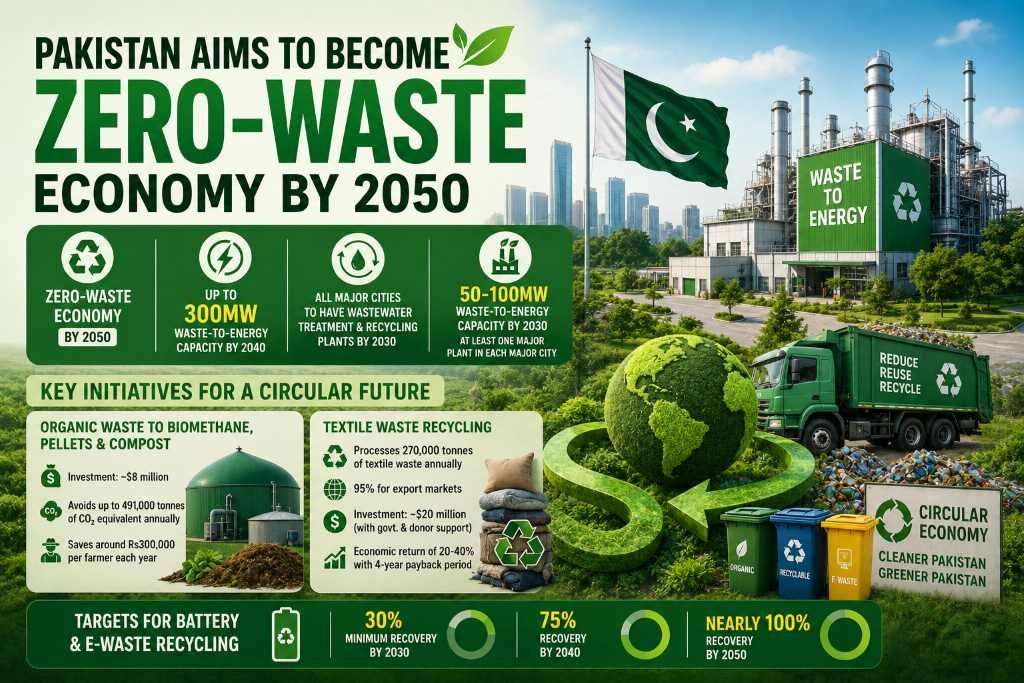

ISLAMABAD, May 10 (Wealth Pakistan): Pakistan aims to become a zero-waste economy by 2050 under a new circular economy strategy outlined in an official document available with Wealth Pakistan.
The strategy also targets installation of up to 300 megawatts of waste-to-energy capacity by 2040. Officials plan to install 50-100 MW of waste-to-energy systems by 2030, with at least one major plant in every major city.
The document outlines a transition towards a resource-efficient system focused on reuse and recycling. It also sets a target to equip all major cities with functional wastewater treatment and recycling plants by 2030.
At the centre of the strategy is the goal to build a circular economy that maximises resource efficiency, reduces waste, and converts used materials into new economic value streams.
As part of the transition, Pakistan plans to establish its first industrial-scale lithium-ion battery recycling facility by 2027.
The strategy also sets targets for recycling electric vehicle batteries and e-waste. Pakistan aims to recover and recycle at least 30% of end-of-life batteries and e-waste by 2030, 75% by 2040, and nearly full recovery by 2050.
The document states that Pakistan’s transition to a climate-resilient and resource-efficient economy requires major changes in the use of materials, water, and energy across sectors.
It notes that rapid urbanisation, industrial expansion, and growing environmental pressures have made the traditional “take-make-dispose” model unsustainable.
According to the document, adopting a circular economy can help reduce waste, extend resource lifecycles, and convert environmental challenges into economic opportunities.
Among the major initiatives, Biowaste Energy Ventures Ltd. plans to convert organic waste into biomethane, pellets, and compost. The project aims to reduce dependence on imported RLNG and lower methane emissions.
The project involves an investment of around $8 million. It is expected to avoid up to 491,000 tonnes of CO2 equivalent emissions annually while generating savings of nearly Rs300,000 per farmer each year.
Another initiative focuses on textile waste recycling. The project aims to process 270,000 tonnes of textile waste annually into products such as rugs and cushions, with 95% of production meant for export markets.
The textile recycling initiative requires an estimated investment of $20 million with support from the government and development partners. The document projects an economic return of 20-40% with a payback period of four years.
The document describes these projects as part of broader efforts to support green investment and strengthen Pakistan’s transition towards a sustainable circular economy.